Tuesday, February 26, 2013

Eve’s Imprint: Where do you come from?


Migration Map: National Geographic Society Genographic Project

In spring of 2010, I began working on Eve's Imprint. This work consists of creating fine art that is based on my thirty-plus years of personal multi-cultural and global experience; a lifetime of reading anthropological, archeological, and genetic research; and discovering my own DNA results through National Geographic Society’s Genographic Project. The intent of Eve's Imprint as an exhibition is to establish an environment that evokes contemplation and reflection on our global family, the human genome. It is an extensive project that will take several years to complete.  

Imagining Eve’s Imprint Exhibition


I currently imagine Eve's Imprint exhibition consisting of twelve alcoves arranged in a circle around an image of the earth as seen from space and encircled by twelve figures that correspond to the alcoves. Marking the perimeter of the center will be pillars that represent climatic realities humans have always confronted such as comet, typhoon, cyclone, hurricane, flood, earthquake, volcanic eruption, and wildfire.


Each alcove will be created by hanging or standing panels that hold paintings. It will contain three-dimensional elements as well as sketchbooks revealing my creative process. Alcoves will be grouped in quadrants that include:

Beginning Our Global Human Journey
1.    Evolving Hominids Produce Homo Sapiens
200,000 Years Ago: Cooled by Sumatra’s Volcanic Eruption
South and Sub-Saharan Africa
2.    Crossing the Red Sea
70,000-50,000 Years Ago: Near East/Levant
Egypt, Lebanon, Jordan, Saudi Arabia, Yemen
3.    Fishing Our Way Eastward
70,000-50,000 Years Ago: Southwest Asia
Iran, Iraq, Syria, India, Pakistan, Nepal


Following Receding Ice into New Lands
4.    Inhabiting the Ice Age Culprit
50,000 Years Ago: Southeast Asia/Oceania
Former Indochina, Australia and the Pacific Islands
5.    Creating Coastal and Cold-Bearing Cultures
45,000-35,000 Years Ago: Northeast Asia
China, Korea, Japan, Mongolia and Siberia
6.     Moving North and West as Population Expands
45,000-35,000 Years Ago: Mediterranean
Balkans, Greece, Italy, France, Iberia, North Africa


Migrating Inland and Westward
7.    Following Animals to Water
30,000 Years Ago: Central Asia
Tibet, Afghanistan, Tajikistan, former Soviet Union countries
8.    Traversing the Caucasus
30,000 Years Ago: Northern Europe
Germany, Scandinavia, United Kingdom
9.    Crossing Beringia
20,000 Years Ago: The Americas
North, Central and South America


Cherishing Our Global Family
10.  Occupying Planet Earth
 10,000 Years Ago: Inventing Agriculture 
 Begins Taxing Earth’s Systems
11.  Sharing My Ancestral Journey
 Merging Mediterranean Cave Painters and 
 Northern European Artisans
12.  Our Common Future
 Witnessing Site-Specific Sponsor's
  Cultural Contributions


The corners of the exhibition space will be discovery centers with videos to watch, books to peruse, binders of related articles to read, as well as emblematic cultural artifacts to observe.


Monday, January 28, 2013

EVE’S IMPRINT: A Global Family


Seven billion people live today on this awesome planet, a place that needs to be returned to a sustainable natural state in order to support continued human life. All seven billion are descendants of one woman in East Africa, Mitochondrial Eve, making us one global family. To save our beautiful planet and to preserve the rich diversity of our family’s many cultures requires a new era of peace and partnership.


After mastering survival skills, Homo sapiens created art. These ancestors collected feathers and bones to wear as adornments, made bones into beads and chiseled images into rock. Some sketched animals on cave walls to assist hunters in envisioning a victorious hunt. Others painted their bodies with dyes derived from plants and minerals for ceremonies honoring nature for her bounty and humans for their resilience.


Because of these ancient roots, visual art, similar to storytelling, resonates with the human heart and inspires acts of caring and daring. In modern times, Picasso’s Guernica confronted humanity with the devastation brought by war. Judy Chicago’s Dinner Party inspired a generation of women to demand equality. Frank Gehry’s Disney Symphony Hall and Guggenheim Museum introduced new visions of construction.


EVE’S IMPRINT aspires to speak to the human heart about our common ancestral roots and diverse cultural creativity. It’s objective is to create fine art that reflects the courage and audacity of our ancestors who left East Africa 50,000 to 70,000 years ago and walked or sailed to every corner of planet earth. Using beauty, color, design, and space, this project will result in content-centered artistic expressions that, hopefully, will occasion a spark of recognition and evoke a desire for reconciliation among the many branches of our human family.


Comments and questions are welcome.

Photo credits: All from Google Images

Friday, December 21, 2012

My Old Friend

"Hello darkness, my old friend, I've come to talk with you again," Simon and Garfunkel sang years ago in their popular song, Sounds of Silence.


The season of darkness is upon us. Whether you call it midwinter, the longest night, the shortest day, the first day of winter, or winter solstice, the latter part of December issues an invitation to slow down after summer's frenzy of activities and fall's exhuberant harvest.

Often we seek to avoid the long dark days that winter brings - constant days bereft of light, months filled with colder temperatures, the bleakness of land, the emptiness of trees, and endless gray skies.
Invitation 1: Ponder darkness as a spur to reverencing the mysteriousness of the universe. 

Our ancestors developed a cornucopia of therapies to help with the transition into winter’s dark days: large ongoing fires and lots of lights; decorating homes with holly, ivy, mistletoe, and evergreens; giving of fresh fruit and holding of feasts; time and communion with family, friends, and close ones; as well as dancing and singing.

Our sister mammal, the northern bear, shows us another approach. She sniffs the air, listens to the sounds of silence all around, and with a great yawn descends into the bowels of the earth for a long winter nap. She truly understands that slowing down is part of a larger natural rhythm and goes willingly into the darkness.

Invitation 2: Reflect upon winter’s wisdom - the need for withdrawal as an essential part of renewal.
Cultures all over the world have taken this time of year to recognize the reality of rebirth. They knew that seeds need darkness in which to germinate and eagerly anticipated that moment when Earth comes forth from this time of withdrawal into a season filled with light.

In Vancouver, B.C., some communities create and then walk a Labyrinth of Light. Lighted with more than 700 pure beeswax candle luminarias, the labyrinth invites visitors to warm themselves in a self-guided ceremony intended to release old attachments and envision new possibilities as a new season is birthed. This mimics an older ritual in which communities kept a fire burning until the end of festivities, to burn away the unhappiness of the previous year.
Invitation 3: Design your own walking meditation in which you
  • Contemplate the elemental beings of earth, air, fire and water
  • Honor the guides, guardians and teachers who have helped you
  • Acknowledge the source of life itself
  • Welcome the devic and angelic forces constantly present amongst us
  • Choose individual angel qualities for support during the coming year
Technically, winter solstice is the time when the Earth’s axial tilt is farthest away from the sun at its maximum of 23° 26, producing longer nights, shorter days. “Solstice” comes from the Latin “sol” meaning sun, and “sistere,” which is “to cause to stand still”. In ancient times, these astronomical events influenced everything from harvests to moods, and so people around the planet observed the occasion in a variety of ways. 


May Winter Solstice 2012 be a time of reflection, releasing of the past, and opening to renewal.


Thursday, November 29, 2012

Altered Vision


Removal of the cataract on my right eye has created a different way of seeing, both visually and perceptually. After left eye surgery last August, I was able to continue functioning with my old glasses. But when the second mono-focal lens went in this month, reality took a twist.
I know nothing about the surgery on the right eye because they numbed me up the gazoo and gave me enough anesthesia to knock me out for a week. That ensured that I did not move during surgery, a good thing, but right eye follow-up has been far more traumatic than the left one was.

Evidently the stigmatism in my right eye needed to be corrected for the newly inserted lens to lie flat. Two extra cuts by the surgeon made the eye swell, creating a weird sensation of being continually off balance. That was a nuisance as I attempted to cut mats and frame giclee prints for a show in December and January. Not being able to read, with or without the old glasses, was a shock. After a week of limited computer use and no reading, I bought some cheap reading glasses.

A check up with my regular optometrist confirmed that healing is progressing just fine but no new prescription can be given until the right eye stabilizes. It seems that takes a month. And then there will be the time it takes for the new glasses to be made. That makes six weeks of seeing with “far vision” as my primary mode. So, with cheap reading glasses strung on a chain around my neck and being continuously pulled on and off, I am making my way through the world.
Initial “altered vision” revelations include:
·       Colors are brighter and clearer.
·       In order to see ‘paintings in progress’ from several distances, the studio easel had to find a new location.
·       From a five-month distance, it is clear that the toaster has lost its right to counter space, being no longer used since I went on the “hunter gather” diet.
·      After attending a mentoring conference to discern how we can better guide our students, I now see that I myself need to be mentored in relation to the next stage of my art career, and possibly for life with altered vision.
·       A short blog is better than none at all.

Photo credits: Justin Wikinator, feathers boutique, Best Image Optical

Thursday, October 18, 2012

VOTE!


VOTE!
Do not allow Romney to Swiftboat Obama. Call out GOP lies :

GET EVERY WOMAN YOU KNOW TO VOTE DEMOCRATIC!
Romney and the GPO will push women back into the dark ages. Have women watch the attached video.

What Women Need to Know


GO TO A STATE THAT NEEDS HELP GETTING VOTERS TO THE POLLS!
Remember hanging chads in Florida. Ohio, Iowa, Wisconsin, Florida, even Arizona can use our help.

Ohio Matters


ALL HANDS ON DECK TO KEEP THIS COUNTRY MOVING FORWARD!
Every vote counts. You can make a difference.

Don't Let it Happen

Thursday, September 27, 2012

Gift of A Mentor


Recently I spent two weeks in Ventura, California in what is called Open Studio. This annual gathering of artists is an opportunity to support and encourage one another and to receive professional feedback from abstract artist Katherine Chang Liu. Some artists attend every year. I go every other year.
Making arrangements to do our art in a place away from our home studio is something of an ordeal. Not only do you have to make all of the travel and lodging reservations, you have to anticipate the work you will do, pack all of the appropriate materials, and ship your “boxed-up studio” to Ventura within the designated time frame.


Preparing to Work With A Mentor
This year I struggled with the Open Studio requirement that you bring eight images of recent work. Two years ago I began a body of work related to humanity’s migrations out of East Africa to every corner of the globe. At that time I focused on our common origins in Africa, completing five paintings in the first year after my last Open Studio. These were published in our book, Art Twenty-Eleven, so I could hardly call them “recent work”.
Since then, I had gotten sidetracked into publishing PILGRIMAGE Wonder Encounter Witness and helping edit four other books. I had also taken 18 months to teach a Heritage Mandala class based on the migration journey of each participant as revealed in individual DNA tests. I did this because I wanted Children of Eve to be grounded in my own truth. Researching each stage of my migration journey and those of my students had resulted in binders filled with articles and online material.

Completing the Heritage Mandala, I tried to get back into painting large again by pulling out former unfinished paintings and practicing on them. I got one quarter-sheet painting out of that endeavor. I call it “My Multicultural Fertility Goddess.”
So my compilation of “recent work” consisted of two paintings: my Heritage Mandala and my fertility goddess. Wanting to conform to the eight images requirement and at the same time be honest, I pulled out two of the visual journals I’ve been keeping over the last couple of years and photographed six pages. That may have been fortuitous.


A Mentor Knows You
During the first two days of Open Studio, each artist has a twenty-minute session with Liu in which she reviews the eight images and discusses what is evolving in the artist’s work. Reviewing my images, Liu allowed as how my mandala could be in a section of the Eve exhibition on my own journey. Good. However, my fertility goddess seemed “too hip” for the Eve series. My heart sank. Continuing through the images, she asked, “Are you into book arts?” “Sort of,” I replied tentatively. I mentioned that I’d been thinking of having installation components with the paintings.
My recent lack of productivity must have signaled an impasse. Liu said, “When content is so large, it’s easy to get overwhelmed. Why don’t you go geographical? You think that way and it brings to mind the culture, the fabrics, the language and food for you. You’re a writer, so start writing. I know you. You work by chapters. Start with Southeast Asia since that’s where the first migration went.”
“Can I use collage?” I queried. “Collage is part of your vocabulary,” she replied. “What about installation components?” I asked. “Your sketchbooks can be part of the exhibition." Bingo! "They can be on pedestals in front of the paintings to which they relate. Maybe you can have some things on the floor.” Relief swept through me.

I went to my space and immediately made a chart of the geographical chapters. I could see how some of the research material I had gathered might be included in the sketchbooks. I took out a new sketchbook and began writing about Southeast Asia. I decided the underlay for each composition would be geographical. Next day I pulled out my maps and began tracing Southeast Asia and the Pacific Islands (SEAPAC).
The geography of SEAPAC is huge. I determined that I wanted Southeast Asia and Australia to be dominant. I decided the islands needed to be two smaller paintings that would visually overlap with a bigger Southeast Asia painting. Together it would be a triptych, with each piece hanging at different distances from the wall.
I brainstormed in my sketchbook, recalling experiences I’ve had in that part of the world. One evening as I reflected in my hotel room the sketch for the triptych flowed from my pencil onto the page. Over the ensuing days I got a good start on the triptych.

A Creative Cyclotron
Most mornings during Open Studio Liu makes a visual presentation. Two I especially appreciated were on Installation Work and Abstraction. Other presentations also fed my imagination.
After the first two days of individual reviews are done, Liu makes daily rounds. She systematically goes artist by artist from one end of the room to the other, checking to see if we have questions. It is not that I or other artists could not figure things out on our own. It is that having her eye helps us move faster.
For example, I had purchased some cloth to experiment with it as collage material. When I showed Liu the sketch for the triptych and told her how I was thinking of using the cloth, she commented, “In working with fabric, use it where wrinkles won’t matter and do layers.” She also suggested that I do another part of the design in layers of paper. I saw immediately that this would complement the cloth, making it not a singular collage element.
The two weeks of Open Studio are an incubator or cyclotron. Mostly we artists work in a semi-conscious trial and error way. When a mentor holds up a mirror and describes to us what she sees us doing, it accelerates our learning process.


Saturday, August 18, 2012


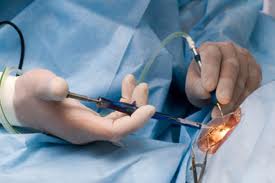
Stop Moving! This is Eye Surgery!


A very pleasant man with a Spanish name introduced himself. He was the anesthesiologist.  Because I detest medications of any sort, I told him, "Keep the anesthesiology light, please." 

“Oh don’t worry. It won’t be much," he said. "You have to be able to hear when you’re asked to move your eye left and right, up and down.”

The surgeon asked, “Do you need anything?”

“I need for you to do good work,” I said with a sigh that revealed my discomfort with putting the fate of my eye in the hands of someone I don’t even know. That was the reason I had postponed cataract surgery for well over a year.

I sat back in their monstrous brown leather chair. The chair shifted to a horizontal position and I scooted up at least a foot to get my head in the right place.

“Can you scoot up another inch?” asked one of the nurses. 

I pushed myself up further and was grateful when she connected a heating hose to the paper gown I was wearing. At least I wouldn’t have to freeze while these two doctors performed their ten-minute surgery.


The nurse placed a mask over my face that had an opening for my left eye. I barely felt the surgeon make two small holes through the membrane covering my eyeball. However, I did feel a slight sensation as liquid entered my eyeball and shattered the cataract.

The surgeon had told me he would be using a miniscule vacuum to extract all pieces of the cataract. Feeling the pressure of the vacuum moving over my eyeball was uncomfortable. I must have squirmed.

A loud voice said, “Stop moving! This is eye surgery.” I have to say, that was pretty scary. I realized that if I didn’t lie still he could poke my eye out.


I felt pressure again when he moved the vacuum to the bottom of my eyeball. “Don’t move!” said the loud voice above my head. The surgeon was a large man so of course his voice seemed loud to me. It also had that edge you hear in a parent's voice when a child is doing something dangerous. 

At that point the anesthesiologist shot something into the IV in my arm. All sensations ceased.

While I was out the surgeon inserted a folded lens into one of the holes he had made. The lens unfolded. From a video I’ve watched, I know he put some sterile drops in the eye to prevent infection.


The loud voice above my head said, “OK, we’re removing the face mask.” I felt it being pulled away and the chair being brought upright. 

I literally floated out of the chair, into the prep room where I was given some orange juice, and downstairs to await my driver. Whatever the anesthesiologist gave me, I was so energized I went into the studio and painted for seven hours. When I sat down to do some mending, I was astounded to be able to see all the tiny stitches I was making.

Post-op sessions have shown that with my intraocular lens, my left eye has nearly 20:20 vision. I find myself filled with gratitude. 

The “strange shot” I was given lasted until five days later. When it was out of my system, all of the anxiety of the experience washed through me. I sat down and cried.

I know that for those two doctors and all of the nursing staff, I was just number nine, the last one of the morning. However, for me, this was “I” surgery! My left eye has always been my weak eye. Now it is the stronger one. The eyelid had begun to sag, probably because the eye was so tired from trying to see through the cataract. Now the eyelid sits up the way it should.

It is very strange to have been awake when the cataract was shattered and removed but to be asleep when the miraculous new lens was put in place. I wonder how often this has occurred without my awareness: watching as the old me got shaken up and thrown away but not being aware of the new me taking its place.

A recent series of dreams has been filled with people (parts of me) dying. I have not yet seen signs of who or what the new me will be. Do you suppose there is an intraocular lens for that? Or maybe when they do the right eye, the new "I" will become visible to me?