Wednesday, March 23, 2016

Nature and Healing

Star Aura - Nature Mandala by LiDoña Wagner

We Are Nature

For millions of years our ancestors and their hominid predecessors roamed in natural settings. They walked, hunted, slept, ate, and procreated under the stars and in the warmth of the sun. When they became ill, they used herbal remedies found in their natural habitat.

With this long history of living as part of nature, is it any wonder that the very ability to see forms of nature – plants in an office, trees in a yard, chickens pecking the ground, cats curled in the sun – has the power to speed healing? Hospital patients who have a view of nature heal more quickly than those with no such view.  Older people who see and interact with preschoolers or walk in nature are healthier and have more positive attitudes than those who do not.

Nature Mandala

Knowing that humans have a primal, profound, and spiritual connection to nature is what prompted me to offer a class on painting a nature mandala in gouache, an opaque Oriental water-based medium. In a technological era where people are beginning to experience nature deficit disorder, painting a nature mandala packs a double dose of healing and centering energy. Firstly, contemplating and painting some aspect of nature provides a link to life itself. Second, working mindfully with the circular form of mandalas provides healing of the brain.

Doodle that inspired Star Aura
I started this painting with the intention to create a sampler for my Nature Mandala class. In doing a series of doodles I arrived at the decision to paint a star aura. I had no idea how I would do this except that I would start with the doodle that had precipitated my decision and it would be based on the rainbow colors one sees in both moon and star auras.

To backtrack a bit. When I began painting many years ago, I watched a video of Picasso working on an abstract painting. Unlike what some of my teachers seemed to be suggesting, Picasso did not appear to have a detailed value sketch that was dictating his actions. Instead, he seemed to be ‘winging it.’ That is, he would make a mark on one side of the painting, study the result, and then make another mark – generally in a different color – in some other area of the painting.

Over the years I have come to appreciate that many artists, myself included, do not start with a value sketch but rather with a vague idea of a concept that they wish to communicate. As an example of this approach, I am going to share a few of the stages of evolution for Star Aura.

When I began, this was as far as I could imagine.

Star Aura Evolution

I selected my colors: 1 yellow, 1 green, 2 blues, 1 purple, 2 reds, and 1 orange. Starting inside the inner circle, I used various mixtures of the base colors - some clear, some with a touch of black, some with white. To make it all pop, I painted gamboge (an orange yellow) between the points and the inner circle. I used a more white version of each base color for the points made by the two squares. I painted the two squares dark green and dark purple. This is when the fun began. The addition of the squares made me realize several things:
  • I needed more points.
  • I needed to rotate the colors around the circle so that the aura would be subtlety mixed.
  • The gamboge circle was competing with all the other colors.
  • The squares were competing with the circles.
Students in my class will receive a handout with step-by-step details on the minute changes that Star Aura underwent. This is not because they will make a star aura – they will not – but because I want them to comprehend how they can bring a vague intention or concept into reality, one small step at a time. Each student will select one element of nature, one that has special meaning for them. It could be a plant, an animal, clouds, waves, whatever.

"No guts, no glory!" is what my teachers used to say
when a student was hesitant to use the dark colors that bring a painting to life.
The result of making changes was that I had something more like a star, but it did not have any of the mystical ‘aura’ quality I was seeking. Stars have deep meaning in most cultures. They guided many a migration or transit. For me they have to do with enlightenment. 

In preparation for painting the background of Star Aura,
I put tape around the edges  of my painting. 
I added more points and painted the inside and edge of the outer circle. Seeing that the star was acquiring some of the subtlety I wanted, I added patterning to all of the points and began to wonder if I needed anything in the background, or if it would be solid.

By now the center was really bugging me. I added dark areas around the central points.

A moment of truth had arrived: I would have to get rid of the original gamboge circle that I had greyed by painting a light blue pattern on it. I scrubbed out the greyed gamboge circle. That means I wet each area and blotted with paper towels until there was little residue of paint. I repainted that area with light blue and put a white pattern on it.

Getting rid of the greyed gamboge circle made a huge difference.
Things appeared to be developing. It was time to deal with the background. This is always an anxious moment. One has to be exceedingly careful not to mess up what you have done. Plus you have to do it as a seamless wash. Professional chefs can tell you about similar critical moments in making some light, fluffy convection.

Using a lighter version of the purple I had originally used on one of my squares, I painted a second edging around all outermost points. This would transition to the light violet color I was imagining for the background. After erasing my test doodles in the corners, I mixed my light violet color. With bated breath, I worked corner by corner - wetting the area, stroking in the paint mixture, working the whole area while it was wet in order to achieve an evenness of tone.

Finally, the mystical quality I was seeking began to reveal itself.

Patiently Keeping Faith

Seeing the painting with its light violet background, I had a slight sense of how I could convert what had become a mishmash of colors and white patterns into a star aura. With the effect of the background as my guide, I began working from the outside in toward the center. In several cases I washed the white patterning into the paint beneath it, creating a lighter color.

Excitement and anxiety were beginning to build as I approached the center of the painting. If you have ever tried to sneak up on some animal, you know the small incremental movements that are required to keep from startling your prey. Something similar happens as you begin homing in on the finish of a painting.

You must take one small step at a time. Observe the result.  Take another small step. Observe the result. Over and over, you nudge toward the effect you are seeking.

My center is taking shape. That requires changes elsewhere in the painting. 
Things were beginning to shape up, but I needed more oscillation of color at the center. So I added light yellow triangles inside the small points surrounding the center. I knew I was close but I was also tired, so I stopped.

Next morning when I was fresh and relaxed, I moved in for the finish. I cleaned and sharpened the dark octagon. The gamboge center was too strong so I lifted it out and put in a light yellow. I added simple frame edges in the corners of the background.


The seed image I nourished with care was realized. 
Voila! From a vague idea about a mystical star aura representing my love and commitment to the wondrous planet I am privileged to occupy,  a vision was realized - one step at a time.

Wednesday, February 24, 2016

Anything Can Happen!

Macrina was a 4th century Greek mystic and visionary who
started a community that emphasized a simple, self-sufficient lifestyle.
Recently a friend invited me to spend an 'anything can happen day' with her in Seattle, Washington. I immediately accepted, unaware that I was about to learn that ‘anything can happen’ is characteristic of Seattle culture. Our first stop of the day was Macrina Bakery and Café at their SODO location on First Avenue South. We had an 11:00 appointment for a tour.

Marina Bakery and Cafe

Macrina Fruit Babka Bread
As we waited in the café of their LEED certified building for the Wholesale Sales Manager to arrive, I stared through big glass windows into the bakery. Over a dozen Vietnamese workers were forming individual bread rolls. Macrina is an artisan bakery in which every item is hand-formed and freshly baked. Translate that to mean it is labor intensive!

The yummy pastries and lunch menu items defy description.
Upon her arrival our guide gave us a brief history of Macrina, beginning with founder Leslie Mackie’s vision of bread as a connective tissue for local communities - as it was and is in places like France and Italy.
Founder Leslie Mackie is fond of anything 'natural'.
Mackie is an internationally renowned chef and baker. It is totally remarkable that in expanding from one bakery and café to three, she and four owners have been able to maintain the basic commitment to hand-formed and freshly baked bread and pastry. They even have an Italian clay brick oven. When purchased, an Italian artisan came to Seattle to install it properly.

Imagine hiring a woman just to remove Rosemary from twigs.
That shows commitment to hand-formed and freshly baked bread and pastry!
I asked about the Vietnamese workers and learned that because of Vietnam’s French connection, people there are familiar with artisan baking. Ok, but how many companies do you know that offer English As A Second Language to their workers and encourage them to speak English in the work place so the lessons will take?

Sip and Ship


Sip and Ship is a local business in Ballard and Greenwood/Phinney Ridge areas.
If I was overwhelmed by how local company Macrina Bakery maintains it's core values, the innovative concept at our next stop, a Sip and Ship business on NW Market Street, took my imagination to yet another level. 

Chairs out in front encourage the feeling of a neighborhood node.
What a business concept: your personal mailbox located where you can receive packages, sit and read your mail with a cup of coffee and a snack or you can buy a gift, have it wrapped and shipped all in one place.

Don't you love the sliding ladder?
Old library concepts have new life in today's world.
With two Seattle locations (Ballard and Greenwood/Phinney Ridge), this innovative little business has won a number of awards.

Did you know that candles are the #1 gift item worldwide?
Can you believe I found a jar of Kale and Parmesan Pesto in their gift area? The friendly site manager is from Atlanta and has introduced some new gift items. Although cards, candles, and bath accoutrements were tempting, the pesto was my one purchase of the day.

Fountainhead Gallery

As a 'lover of light' Fountainhead Gallery won my heart immediately.
And then ... a real treat for this artist ... we landed at the Fountainhead Gallery on quiet but quirky McGraw Street on Queen Anne hill. While I enjoyed the hustle and bustle of our first two stops, I welcomed the serenity and spaciousness of this sophisticated gallery.

A staircase to the second level provides a view of the entire space.
We were welcomed by the Gallery Assistant who gave us a first class tour. I loved how even the storage area walls were filled with lovely art, adding to the gallery space, providing a feeling of openness, and an awareness that art belongs in every room.

What gallery do you know that has a mini stage that is perfect
for intimate musical performances?
In addition to the upbeat atmosphere created by light streaming in through storefront windows and skylights, the gallery has a small stage that makes musical events a snap. In addition they make use of a lovely table in front of an inviting heating stove for book signings.

This gallery knows its audience and enriches their lives in a variety of ways.
Displaying regional and local artworks for twenty years, Fountainhead Gallery understands customers want a variety of cultural events as well as a chance to meet artists. All of the arts support and feed each other and people today seek participation and interaction as well as an opportunity to view good visual art.

The open floor plan allows for multiple space configurations.
Located on a precious corner spot near neighborhood businesses and an elementary school in a close knit community, this gallery is situated to grow into a neighborhood cultural center with an ongoing series of musical events, artist demonstrations, and art workshops to accompany its beautifully displayed art. Need I mention there’s a Macrina bakery and café just down the street?


My hostess and event planner was Leah Early (left). 
Clearly in Seattle, anything can happen, and does! Whether it’s Microsoft, Macrina Bakery, Sip and Ship, or Fountainhead Gallery, the entrepreneurial spirit is alive and well in this Northwest city.

For those of you who know Leah and Lee Early, it will not surprise you that the Wholesale Sales Manager of Macrina Bakery is daughter Rebecca Early, Co-owner of Sip And Ship is Diana Early Naramore, and Fountainhead Gallery Assistant is Laura Early. With a father who is a business consultant and a mother who is a former speech and debate coach, these entrepreneurial women had a leg up on making a splash in Seattle.

When was the last time you had an ‘Anything Can Happen’ day?


Photo Credits
Macrina Bakery: #2, 4 Macrina Bakery website: #1, 3, 5 LiDoña Wagner
Sip and Ship: LiDoña Wagner
Fountainhead Gallery: #2, 3, 4, 5 Fountainhead Gallery Facebook page: #1 LiDoña Wagner
Leah and LiDoña: Ballard Sip and Ship location manager

Tuesday, January 26, 2016

Mission Accomplished (Almost)

One of my 2015 goals was to complete both the Southeast Asia and Southwest Asia sections of Eve’s Imprint. I had been working on SEA since 2012 when I still held a full-time job. In 2014 during my residency in Italy I digressed to paint a volcanic eruptions banner, the largest single piece I have ever done. At the beginning of 2015 I was primed to return to my work on Southeast Asia and bring it to completion. It was not as hard as I’d anticipated and culminated with creation of the Ecosystems stick map in February.

So I moved on to Southwest Asia and was rolling along nicely until I had a fall at the end of August in which I broke my right hand and injured my left shoulder. These injuries brought my painting to a halt for about six weeks and then I had to work slowly for a while. I pretty much kept quiet about this fall because I am embarrassed about being such a klutz.

As the end of 2015 approached, I was determined to finish Southwest Asia, so I worked through the holidays, completing the pieces I'd envisioned on January 31st - New Year’s Eve day.

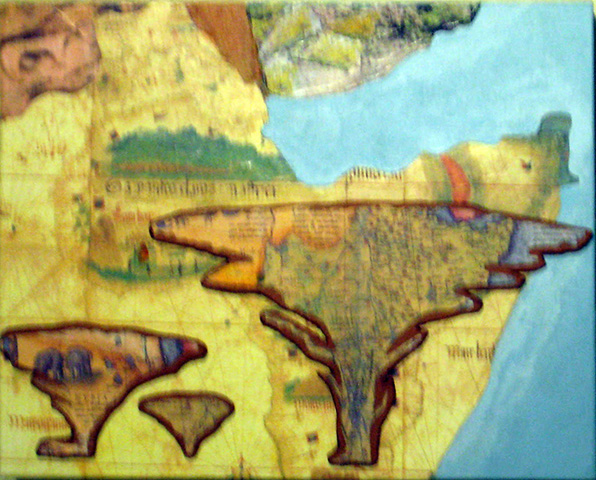
The southern end of the Red Sea shown as it enters the Gulf of Aden
at the northern coast of the Horn of Africa.


Genetic scientists believe that Homo sapiens left Africa by crossing the Straits of Grief at the southern end of the Red Sea 70,000 to 60,000 years ago. In other words, the horn of Africa (Somalia, Eritrea, and Ethiopia) was our jumping off point for the maiden migration of Homo sapiens out of Africa into the unknown wilderness beyond.

Stephen Oppenheimer, a British scientist whose studies form a large portion of the 2003 discovery channel video, The Real Eve, opines that eating fish accelerated the growth of both the human brain and the human population. He says that perhaps the fish supply was strained by this population growth and prompted people to look across the Straits of Grief and long for the ‘green hills of Yemen’.

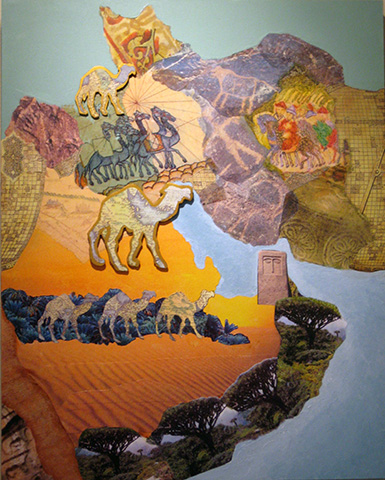
The grid images on the left side of Arabia and to the right of Iran are
from an Islamic map created in the middle Ages. The writing in the grid
gives the coordinates of geographic locations, to be used in determining
the direction of Mecca for prayers.
The Arabian Peninsula was not always desert. Apparently it has oscillated between fertility and desert more than once. Those migrants who survived the crossing of the Straits of Grief landed in a botanical garden. Some of these original migrants stayed in present day Yemen and after a time - as they multiplied - migrated north by land. At least an adventurous few continued by water along the coast, arriving in present day Iran.
On the left is Iran and on the right are Pakistan and Afghanistan.
The battle from the backs of elephants is a transfer of cave art.
Most likely some of those migrants, upon touching the shores of Eurasia, were captivated by the river-fed lands they gazed upon and decided to stay. The fertility of the land aided their population expansion and they followed both rivers and land further inland and within 10,000 years, many had settled in Mesopotamia (present day Iraq).

Once again, there were those migrants who preferred a maritime existence and they continued along the coast of present-day Pakistan. As they sailed, they dropped off a few of their number in various places. Perhaps there were pregnant women or small children who needed to stop for a while. And of course, as we all know, once you have paused and found a hospitable place that nurtures body and soul, why would you return to an itinerate life? Some of these coastal people eventually made their way north into the Indus River Valley where they created a culture that rivaled that of Mesopotamia. Others continued north into present-day Afghanistan. 

The tiles at the top are to indicate the height of the Himalayas
and how they formed a barrier to Asia. The map in the lower right
shows DNA mapping of migrations.
At least an intrepid few adventurers continued along and around the vast coastline of the Indian subcontinent. There they found fertile land, inviting caves, and the majestic and ferocious Bengal Tiger. It would have been a courageous covey of migrants who decided to enter a land ruled by tigers, elephants, and other dangerous animals. For whatever reasons, some migrants did indeed stay and before the beginning of the first millennium of the current era, some had reached the Bhimbetka caves in central India and inscribed their understanding of life on the cave walls. Most of my India and Pakistan cave art images are from these caves. Remember, until the mid 1940s, Pakistan and India were one country.

Other migrants found their way by water to the islands known today as the Maldives, the large island known today as Sri Lanka, and further to today’s Nicobar and Andaman islands. A goodly portion of these maritime migrants continued on into Southeast Asia.

Once I had my tiger and tiles done, I had to do a make-over
on the Nicobar Islands at the lower right.
I had a friend join me on New Year’s Eve and after viewing the newly completed Southwest Asia panels, she spotted the Southeast Asian Ecosystems Stick Map. She immediately pronounced, “You have to do a three-dimensional piece for Southwest Asia.” As soon as she said it, I knew she was right; I guess I didn't quite make my deadline after all.

We brainstormed how these adventurous migrants would have navigated from one place to another. In prehistoric times Homo sapiens were keen observers of natural and celestial patterns and gradually created navigation tools to help travelers make their way through distant lands and seas. I did some research and found that by the time of the Greeks an instrument called an astrolabe had been invented. Later I will tell you more about that and the 3D piece I now envision for Southwest Asia.

I apologize for the poor quality of my photographs. They do not reflect the sizes of the pieces: In inches, Horn of Africa is 10 x 8, Arabia/Iran is 16 x 20, Iran/Pakistan is 6 x 12, India is 18 x 24 and the islands are 4 x 6, except Sri Lanka is 4 x 4.

Saturday, December 19, 2015

A Season for Contemplative Action

Japanese Crane 
Here in the northern hemisphere, Winter Solstice approaches like the whispering sound of bird wings. Soon we will teeter on the edge - the shortest day and longest night  - before falling into the infinity of returning light. Winter Solstice is my favorite holiday because I am in love with light and the silent moment by moment increase of light fills me with hope precisely when I need it most – during the cold and darkness of winter.

Moreover, the solstice is that moment in time when the opposites are held in tension: light and dark, long and short, winter in the northern hemisphere and summer in the southern hemisphere, youth and age. Each has a unique energy. It reminds me, a lover of light and of uplifting experiences, that life is about holding the opposites in the sort of dynamic balance one sees in certain Japanese prints.

For a quarter of a century I have been celebrating a ritual of 12 Days of Christmas – a time of gifts of self affirmation as I celebrate the divine child within each of us. This year the season of the solstice has announced itself differently, calling me to celebrate a Season of Contemplative Action.

Freedom of Religion is protected by
the US Bill of Rights.
A Season of Contemplative Action
I heard this call when a certain self-proclaimed demigod and presidential candidate denied a fundamental underpinning of American democracy – the right of religious freedom. The first European pilgrims to the shores of North America came because they sought freedom from religious persecution. Thus they enshrined religious freedom in our Bill of Rights.

When I read that this man - I refuse to lend energy to him by even saying or writing his name - is advocating the exclusion of Muslims from our multi-cultural society, I said, “Maybe I should retire to a contemplative convent and pray for the souls of such deranged fear mongers.”

Then I realized that as a solitary person, I already live in a place of contemplation. I do not need to go somewhere else to perform acts of contrition. Thus began the making of lists for a season of contemplative action.

Photo from Central Asia Institute's Pennies for Peace.
The education of girls is the surest road to peace.
12 Life Affirming Acts
Honoring others with gifts of gratitude for their presence in my life and for the gift of life on earth

Probably because I have had a gratitude practice for a number of years, it is fairly easy to see the small acts I can do to honor nature, my neighbors, my family, my friends, and benevolent organizations such as Central Asia Institute and The Malala Fund. Many of these acts - such as feeding the birds, caring for a public garden, and putting up lights that my neighbors can enjoy - give me joy as well.

12 Calls to Turn My Life Around
 Standing present to my shortcomings

Acknowledging my personal transgressions is a difficult list to face. Clearly I harbor harsh feelings toward political reactionaries and fundamentalist religious fanatics. Though I know better, I still pollute my body with sugar and dairy products, by not drinking enough water, and not eating enough green leafy vegetables. I have a terrible habit of having my head in the clouds when I walk, leading to four falls in the past decade. Not to mention my lack of patience with rule-bound ‘service’ providers and institutional bean counters. Many of you could provide me with more suggestions for how I can become a better member of the human Community!

Photo from Central Asia Institute's Pennies for Peace 
program in which elementary children collect pennies
and send them to help girls receive an education.
12 Calls for Intercession
Dedication to the alleviation of suffering near and far  

Your list of places, people and issues that require attention and care would no doubt be slightly different than mine. But perhaps we can agree that it was heartening that 195 nations around the world signed the Paris Accord, committing to reduce the amount of carbon with which we are polluting planet earth. Having Russia, Syria, United States, Arabia, and Iran agree to look for middle ground for ending the civil war in Syria is certainly a welcome sign toward peace on earth.

What would be on your lists? During this time in which darkness submits to light may each of us contribute to ...

Peace on Earth

Good Will Toward All