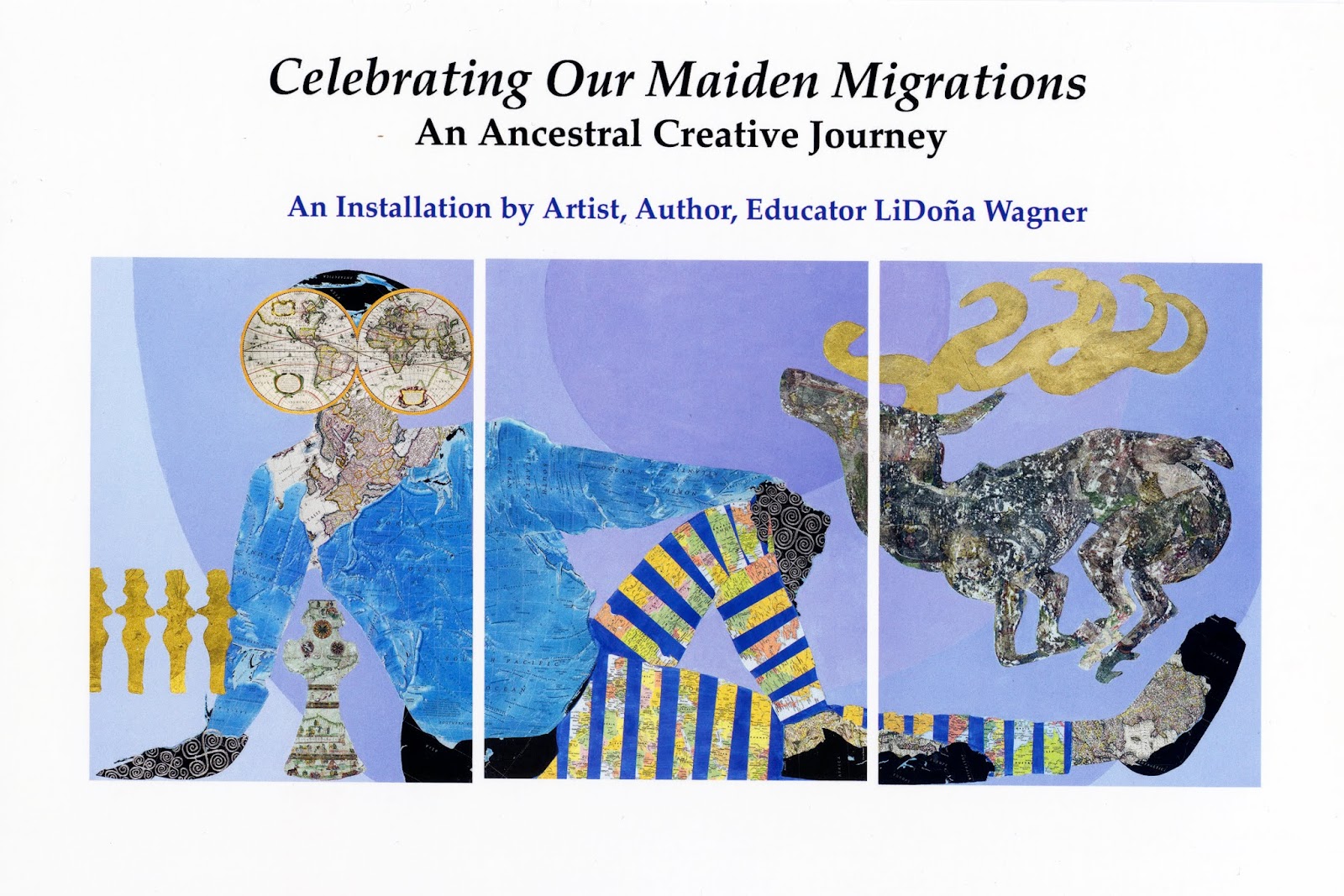
Sunday, September 29, 2019

Trusting Inner Guidance

Where do you turn when a decade-long project appears to be coming to an end or morphing into something not yet fully grasped? I often go to my Tarot cards for navigating such transitions, so in July, as I began recouping my energy after the exertions involved with showing my installation Celebrating Our Maiden Migrations, I pulled out my Osho Zen Tarot deck. Flipping the manual to Card Spreads or Layouts, I spotted one I had never used before – The Flying Bird.


After scanning the description, I decided to go for it when I saw that it involved both the masculine and feminine sides of myself and that each card higher on the layout would move me “into greater clarity and inner spaciousness. As I read the cards, I found myself deeply moved. 

After living with the results for a few days, I decided that I wanted a personal visual representation of the messages I was receiving and decided to make a ‘rood screen’ – a collage of images glued to the inside of a file folder. The file folder would allow me to fold my collage up to take anywhere and would be strong enough to stand up wherever I placed it. Here are the results of my reading with my personally selected images.

1.     Bottom / Lift-off 
TRUSTING INNER GUIDANCE


2.     Left side / Fear of Flying 
LETTING GO INTO NEW DIMENSIONS


3.     Right side / Response-ability to the Fear 
SHARING VIA COMMUNICATION


4.     Left side /Inner Support (intuition) of Responsibility 
REMAIN AT EASE


5.     Right side /External Support (intelligent action responding to the intuition) 
EAGLE’S VIEW OF POSSIBILITIES


6.     Left side / Relaxation and Acceptance 
ACCEPTING CHALLENGE OF THE UNKNOWN


7.     Right side / Arrival at A New Level of Awareness 

SPIRITUAL SPRING OF MATURITY


Final Rood Screen 


Tuesday, August 27, 2019

Emptiness Refills itself


Supplies are neatly tucked away in the closet.
After packing everything for the Seattle exhibition of Celebrating Our Maiden Migrations my studio was empty, both physically and emotionally. Upon my return, I removed vestiges of the migrations project from the studio door, replacing them with the seven chakra colors. Then to make room in the bedroom closet for storing Maiden Migrations, I removed a rack of necklaces that I love and enjoy. I moved the rack to an 'empty' wall in the studio and above them I hung some of the India migration mementos.

The stick in the corner will be an elephant to go
with Southwest Asia in future exhibits. 
Shortly after this move, I received a donation request for one of my 'framed jewelry pieces.' I had donated two in the past: a small sculptural pendant and a butterfly pin. Curious about this jewelry synchronicity, I agreed even though I had no idea what I would create.

One move always triggers another and while hanging the mementos I noticed that my painting table had been gathering dust under an open window. I decided to move the table down a bit where it would catch less dirt. To do this I needed to move a large vertical storage unit out of the corner, replacing it with a smaller unit that serves as my cutting table. 

The maple tree outside the window makes this a desirable painting space.
After rolling the large unit to another corner, I collected a few items that inspire me and put them on the top: tree seeds and bark from Venezuela, a sea fossil, a succulent, an Egyptian bird, a table runner from Thailand, my zen toned clock, and an Aboriginal Australian picture of the Creative Power of the Universe. 

I completed my inspiration corner by adding some
inspirational quotes to the exposed side of the large unit.
Just then, I got an unexpected email from my gallery in Seattle with early plans for the December group show. Would I make/send two new pieces for a show focused on 'light'? Thinking maybe I could do something with my recent Gelli prints that have a lot of white (last month's blog), I said "Yes."  Since distance allows me to see things better than close up, I laid the prints on the floor.

Meanwhile, during a wire-wrapping workshop at a local bead store, I created a bird's nest pendant for my 'framed jewelry piece'. I decided to suspend the pendant on a string of tiny beads, simple but elegant. This meant I needed an unusual frame. After finding some frame options at Goodwill, I began fiddling with them, the Gelli prints, and the pendant. Getting up and down from the floor, it struck me that this was an awkward way to develop these projects. So I pulled a five-foot long table out of storage and set it up in the middle of the room.

My painting on the back wall, Maiden Mother Crone, reminds
me that the mothering phase of my life is over. The new priority
is sharing whatever wisdom I have gained.
 After a couple of days, I found that it was in the way of my other work spaces. Examining my options, my eyes landed on the round glass table that I use for seated work and for helping students. I discerned that switching the tables would make work flow between areas easier. Voila!

Table for my 'framed jewelry piece' and two 'light' compositions.
For final work on these I will hang them on the wall behind the table. 
I love my new studio space. The empty studio has been filled with new projects about which I knew nothing when I returned from the Migrations show in Seattle. It feels as though the empty future is beginning to overflow with possibility.


Wednesday, July 24, 2019

Becoming A Generative People

Becoming Generative LiDoña Wagner Gelli print 2019
A self-aware aging population in the United States could be one of its greatest resources for dealing with our national crisis in democracy. Four keys to living a long and healthy life - purpose, generativity, relationships, and face to face contact - align with addressing our nation's systemic problems: economic inequality, decline in government investment in public goods such as education and infrastructure, political polarization, and unfair and insecure elections that result in low voter turnout.  
Purpose LiDoña Wagner Gelli print 2019

Purpose: Address Economic Inequality

By devoting time and energy to creating innovative solutions to economic inequality one can have a life of purpose. While economic inequality is at the root of violence and mass incarceration here at home, it is also is a major cause of international migrations that are exacerbated by climate change. Here at home, 1% of the population controls more wealth than all the rest of us. Globally, consumption in the northern hemisphere is 32 times that in the southern hemisphere. While people in North America and Western Europe have turned a blind eye to this imbalance for decades, starved and exploited populations in the south now understand that the global economic system is stacked against them. New national and global economic policies are critical.

Generativity LiDoña Wagner Gelli print collage 2019

Generativity: Invest in Education & Infrastructure

The evolution of Homo sapiens occurred through investing in, caring for, and developing its off spring. Thus, our ancestors developed education that would prepare the next generation for the future and created public goods such as libraries, infrastructure, research in agriculture and health, and civic spaces for dialogue. Today we see this beginning to happen locally where people are taking employment and climate issues seriously. Two women in Utah were able to bring wind power into the state’s electrical grid. (Note: On a daily basis, family cats kill over 200 times more birds than wind farms do.) Solar farms in Georgia are being coupled with regenerative agriculture to bring new jobs and sustainable farming to its outlying areas.  

Relationships LiDoña Wagner Gelli print 2019

Relationships: Overcome Polarization

In Jared Diamond’s Upheaval, Turning Points for Nations in Crisis, he uses a model from crisis therapy to present historical examples of how seven nations addressed crises. Most chilling for me was Chile at the time of the US/Cuban missile crisis. The shift from a democracy into a dictatorship happened largely due to political polarization. In the United States today, we need to develop relationships that transcend age, geography, religion, and political boundaries in order to restore our identity as a democracy with freedom and liberty for all.

Face to Face Contacts LiDoña Wagner Gelli print 2019

Face to Face Contacts: Invigorate Democratic Participation

Youth from Parkland have taken their concern about school safety into the field, making face to face contacts that have opened fresh impetus for gun safety. Whether or not Elizabeth Warren wins the Democratic Party’s nomination for the presidency, she is doing our country a service by conducting a grassroots campaign that engages people in face to face conversations about what is needed for the future of local communities and the nation as a whole.

How are you engaging in face to face contacts? Do you take public transportation and greet the bus or tram driver? Do you engage in conversation with your grocery checkout person or thank those who deliver your packages and mail? Civility is a learned skill.

Regardless of your age, you can begin living a long life now by declaring a purpose, investing in future generations, developing cross-bias relationships, and being open and responsive to face to face contacts.


Wednesday, June 19, 2019

Maiden Migrations Launched

Welcome to a Visit with Our Ancestors


LiDoña Wagner’s artistic work honors the courage and innovation of our ancestors who left East Africa 75,000 to 50,000 years ago and walked or sailed to every corner of planet Earth. The intent of the installation is to establish an environment that evokes reflection on our global family, the human genome. 

Our African Homeland

Homo sapiens evolved in Africa more than 800,000 years ago. All humans alive today are descendants of those first Homo sapiensFrom a tiny population, they multiplied and migrated to every corner of planet Earth.

Southwest Asia

The first Homo sapiens to leave Africa crossed the Gate of Tears at the south end of the Red Sea around 75,000 - 60,000 years ago. Navigating by sun, moon and stars, they followed the coast (and fish) going east. Some humans settled in areas along the way, a tiny blip in a world dominated by wildlife. Their descendants are found today in Arabia, Iran, and India.

Southeast Asia

A seismic eruption 72,000 years ago on the island of Sumatra sent volcanic ash as far away as India, affecting the earth’s climate. Descendants of the first coastal migration from Africa reached Southeast Asia 60,000 - 40,000 years ago. For centuries the fertile Mekong Delta drew migrants along the coasts and up and down the numerous rivers flowing from the Himalayan mountains.

The Global Journey

Migration maps from the geneographic project of the National Geographic Society
The Rising
Introducing Homo sapiens first land migration into the land of the rising sun,
later called the fertile crescent.

Ancient Near East

During a warming period on planet Earth 50,000 years ago, a second wave of Homo sapiens left Africa.They traveled north by landfollowing animals they hunted, through the Nile Valley and into the Sinai Peninsula.These adventurous migrants expanded into the region known today as the Middle East, laying foundations for Western civilization.

Perilous Majesty

Catastrophic environmental events occasion migrations

Oceania

Descendants of the first coastal migration reached Australia 60,000 - 40,000 years ago. Millennia later, 13001200 years ago, the last part of the world to be occupied by Homo sapiensthe PolynesianIslands–was reached by indigenous Taiwanese sailors. Through oral tradition, their descendants pass on sophisticated navigation skills: celestial knowledge, wave and wind patterns, sea creature habits, kinesthetic reading of water currents, and more.

Wagner's Ancestral Journey

The migration path of my maternal ancestors, disclosed in a 2010 DNA testis depicted on My Ancestry stabile to the rightSelf-portrait above reflects updated information from a second DNA test in 201341% of my DNA matched that of people in Denmark (Deer– maternal ancestors); 40% matched that of people in Tuscany (Hand symbols – paternal heritage); 17% matched that of people in Southwest Asia (Goddesses –ancestors of first coastal migration).

Resources for Maiden Migrations 

Binder of Wagner's DNA results from geographic project and book covers as
a sampling of the many resources used to develop this body of work.

The Human Journey  

Going upstairs to view works for sale.

Stone Age Series

Stone Age paintings on the right

Mementos of Maiden Migrations 

Elephant Hunt and Dingo Dog

Archaeological Dig

Transition from Pilgrimage series to Maiden Migrations
Creative Process Accordion Books
Mementos and accordion books from residency in Assisi, Italy

Mementos of Maiden Migrations 

Mementos for Africa, India, and the Middle East

Breakthrough

Transition from Stone Age to Pilgrimage series

Ancient Civilizations

Memento of Indus Valley civilization in what is currently Pakistan

Continuing the Journey

Returning downstairs to continue the human journey

Sunday, May 12, 2019

Seed of Imagination


Sunday, April 14, 2019

Fountainhead Press Release


April 13, 2019
Seattle WA

Celebrating Our Maiden Migrations |An Ancestral Creative Journey: Inaugural Exhibition Exploring Human Migration from East Africa to be Installed at Fountainhead in Seattle


Celebrating Our Maiden Migrations |An Ancestral Creative Journey presents Homo sapiens’ origins in Africa and subsequent migrations into the Arabian Peninsula, Southwest Asia, Ancient Near East, Southeast Asia and Oceania. This museum destined exhibition coincides with the release of Wagner’s latest book Seed of Imagination: An Ancestral Creative Journey. Copies of the book will be available at Fountainhead.

Exhibit Title: Celebrating Our Maiden Migrations |An Ancestral Creative Journey 
Artist: LiDoña Wagner
Display Dates: June 6 – 29, 2019
Artist Lecture and Book Signing: Saturday, June 8, 5-7pm (ticketed event)
Artist Reception: Sunday, June 9, 5-7pm

Additional Background:

Our Maiden Migrations |An Ancestral Creative Journey is Part I of Eve’s Imprint, a two and three-dimensional mixed media installation by LiDoña Wagner that traces human migration from East Africa to all parts of the world. The installation encompasses over thirty original pieces of art including mixed media pieces and kinetic sculptures. It is accompanied by narrative panels and guided narration. Viewers are invited to explore their own ancestry, migration as a timeless reality and human impact leading to extinctions and climate change. 

LiDoña Wagner is an active artist and author. Her creative work expresses her passion and commitment to all people and the environment. Wagner’s paintings hang in private and public collections in Australia, Canada, Egypt, Mexico and the United States. Articles on her artwork have appeared in American Artist and Palette magazines. Wagner holds a master’s degree in Literary Nonfiction from University of Oregon. Her first book, Pilgrimage: Wonder, Encounter, Witness was published in 2011.

Fountainhead Gallery welcomes inquiries from groups who wish to engage further with the exhibit.

Thanks to our amazing artists, community and loyal patrons, Fountainhead Gallery has grown over the past 23 years to become a vibrant cultural center in the heart of the Queen Anne community.  Fountainhead Art + Culture presents fine art, artist talks, a speaker series and intimate concerts.


Contact information:

Andrea Lewicki
(206) 285 - 4467