Monday, June 27, 2011

Pilgrimage is Here


25 years in the making, PILGRIMAGE Wonder, Encounter, Witness is coming out in a private pre-retail edition in two weeks.

People reviewing proof copies say, “This is a treasure.” “What a gorgeous book!” “I want copies to give as gifts.” 

What sets Pilgrimage apart is not simply its beauty; it’s the layers of meaning it holds. In the first section I share where I went, what I saw, what I did, what I gave, what I received. This is done through photographs, maps and brief contextual material.


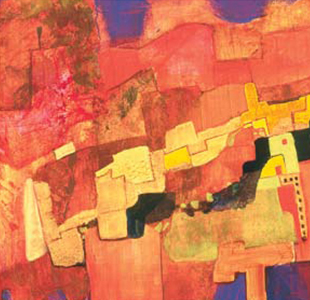
The second section displays amazing color reproductions of the 17 paintings in my Pilgrimage exhibition. Two sentence blurbs invite the reader to explore each work of art.

Anecdotal stories that accompany the paintings comprise the third section of the book. Each story has color details cropped from the painting it narrates. This makes it easy for the reader to move back and forth between stories, paintings, and photographs.


In gratitude for the many persons who have assisted in bringing this dream into reality, I am making 75 copies of this private edition available to followers of my blog at the printing cost of $17.50 plus shipping.

Of course, I’m hoping those who get Pilgrimage at the special private edition price will fall in love with it and encourage people to buy the retail edition when it comes out in the fall. 

Monday, May 30, 2011

Dream Deferred


My necklace broke. Beads spilled and bounced down the stairs. They rolled into nooks and crannies that my fingers could not reach. I sat on a step and cried. Waking from this dream twenty-five years ago, I knew at a wrenching gut level that the project upon which I had embarked would not come together.

I had read and reread pieces written in brief workshops I’d conducted while on the road doing fundraising. Surveys from colleagues who had worked in community development projects told of drip irrigation that made a desert bloom, shrimp farms that tripled family incomes, and healthcare workers who reduced infant mortality. But something was missing. I could not grasp the story that needed to be written. Where was the string to hold these precious jewels?


Concluding that I was not skilled enough as a writer, I resolved to learn to write in a way that made people, places and events come alive on the page. I imagined that a writing workshop with Vivian Gornick would be the magic pill I needed. I was wrong. Each workshop and writing venture led to another.

As I pursued my ambition of becoming a writer, my daughter became an artist. I began taking art classes so I could converse with and encourage her. With no forethought or planning, I fell in love with the creative process of using paper and pigment to express my inner world. I moved back and forth between visual creations that unleashed sensory memories words could not capture and my conscious struggle to become a writer. 

I had a column and wrote feature articles for a magazine in British Columbia. I finished an unpublished memoir that helped me separate my identity from that of the organization for which I had worked. I published poems, wrote unaccepted book proposals, edited journals and newsletters, and completed a manuscript on women’s empowerment.

And always I journaled, hoping that I would stumble upon the story of what had so profoundly moved me in my work with impoverished communities  – the unwritten story that launched me on the quest to become capable of telling my truth so others could grasp it. 

My daughter died and I grieved.


Just as I was accepted to do a master’s degree I met Katherine Chang Liu, an Asian American abstract artist who grew up in Taiwan. Unlike other artists with whom I’d studied, and there were many, Liu was not peddling tricks and techniques. She sought to reach into each artist’s heart and unleash her personal vision. I made a date with Liu to study with her two and a half years in the future.

A master’s degree in literary non-fiction did not make me a book author. Perhaps writing was not my destiny. Returning to brushes and paint, I kept my date with Liu. Arriving at the open studio, I knew exactly what I wanted to paint – Third World villages that had imprinted themselves upon my heart and psyche. Prodded by Liu, visual memories tumbled easily from pencil to sketchbook. Colors to express my feelings swam before my eyes. Within two years the village series was well underway. 


When no local gallery wanted to show the work, I became discouraged. Liu would not accept despair. “Do the work. Send me slides so I can show others what can happen if they undertake a series of paintings with a sincere purpose. And you’d better send me some of those stories you tell about each village painting so I know what I’m talking about when I show the slides.”

So the stories began to be written. An anecdote and a poem were retrieved from the beginning of my writing quest. A feature story was abbreviated. As memories were recorded, a few paintings that had slipped out unconsciously were recognized as part of the village series. Liu suggested the material I’d sent hinted of an exhibition proposal. Colleagues pushed me to figure out how to position the work and where to submit proposals.

Pilgrimage: Wonder, Encounter, Witness was born - seventeen paintings and anecdotal stories that express the wonder of places where I lived, encounters that forced me to examine who I am, and the amazing courage and ingenuity I witnessed in the people I met. Three exhibitions hit the calendar, back to back. One gallery wanted photographs and artifacts, so I reached out to former colleagues and they responded. Each exhibition was a milestone.


But Liu was not done with me. “LiDoƱa, don’t you think there should be a book? I mean, shouldn’t you take Pilgrimage beyond Oregon, and don’t you think you need a book to do that?” Oh my god, do you really want me to do that? Well, all right, since I have all the contents, I might as well. It will be a nice memento for my granddaughters.

Nine months later, as the graphic designer and I prepare to send my book of paintings and stories to the printer, I wake from a dream and it hits me. This is the book I wanted to write twenty-five years ago. A few precious beads have been strung. The missing string was Pilgrimage – a sacred journey to honor the mystery found in every place, person, and culture.


Photographs by Bruce Robertson, David Zahrt, Tim Lush, Gloria Santos, Walt O'Brien

Friday, April 29, 2011

“Wicked” Myth Making


Have you seen the stage play Wicked, a prequel to the Wizard of Oz? It “explains” how the Tin Man lost his heart, the Lion lost his courage, the Scarecrow lost his brain, and the Witch of the West came to be called “Wicked”. It’s about myth making in the negative sense - how lies, deceit, and popularity become confused with history. You might see shades of Sara Palin and the Tea Party. Here’s a quick recap.
Elphaba, Witch of the West, is born with green skin. She suffers the sticks and stones hurled at those who are different, especially those who possess extraordinary powers such as she has.  When her school’s history teacher, a goat, is caged and forced to stop speaking and teaching, Elphaba gets angry and lets loose some of her power. The headmistress, Madame Morrible, is so impressed that she decides to take Elphaba to meet the Wizard of Oz.
Glinda, Witch of the North, is an egotistical, self-righteous, goody two-shoes whose mission in life is to be the most popular person on the planet. She tags along with Elphaba to meet the Wizard.
The Wizard gives Elphaba a book of spells and goads her into reading and using one of them. Elphaba discovers that the Wizard is all smoke and mirrors and that she has greater powers than either the Wizard or Madame Morrible. The Wizard tries to placate her by telling her there is no truth; history is just what a lot of people agree to believe.
At this point Elphaba decides to leave the Wizard and free the caged and muzzled animals in Oz. The Wizard imprisons her and Glinda. Elphaba decides to defy gravity and fly free. She invites Glinda to join her, but Glinda is afraid and refuses. Elphaba grabs a broom and rises up. She sings my favorite song, “Defying Gravity.” Elphaba flies freely and goes about Oz releasing the animals. This provokes the Wizard, Madame Morrible, and the people of Oz to call her “Wicked.”
Meanwhile Glinda announces to Oz that she and Fiyero are engaged to be married. Fiyero is shocked. He is in love with Elphaba and has not asked Glinda for her hand.  When Fiyero goes searching for Elphaba, Glinda gives the Wizard and Madame Morrible information that leads to the death of Elphaba’s sister Nessarose, Witch of the East, (the one with the red slippers) and the capture of Elphaba.
The people of Oz think they have succeeded in killing Elphaba and Fiyero, but the couple actually escape and go underground. Glinda, deceitful but popular, is crowned “Good” Witch of the North. Elphaba, who understood the importance of nature and set about caring for it, is forever known as the “Wicked” Witch of the West.
Truth is often trampled underfoot and forced to go underground. There it gathers energy and erupts in surprising ways, much like current movements for democracy in the Middle East.

Tuesday, March 29, 2011

Visions of Hope

What if, just as you were ready to enter high school, there were a drought in your region of the world and your family didn’t have money for the regulation shoes or mandatory fees? What if the only library near you was a room with used textbooks from the United States? What if the drought created a famine and the famine were accompanied by an outbreak of cholera?

Faced with these mind-numbing circumstances, William Kamkwamba of Malawi, a poor country in Southern Africa, did what others only talk about – he became the change he hoped to see in the world.

It began when William saw a picture of a wind farm in an old text book. Intrigued by the picture, he attempted to read some of the English words surrounding the picture. That smattering of words gave him a vision of possibility – wind power could create electricity and pump water from a well. Inspired by this vision, William decided to build a windmill.

Despite never having built anything of scale, having no supplies, and knowing nothing about electricity, he set about his task. When others saw William combing through the junkyard in search of usable materials, they labeled him a madman and treated his family with derision. Yet William persisted and his father, though not understanding William’s vision, gave him time from fieldwork to keep tinkering away.

Day by day he found pictures in the textbook and deciphered words related to each image, gradually conquering one concept after another. For each mechanical device necessary for the windmill, he drew models on pieces of scratch paper. Mounds of junk covered the dirt floor of his room. Sections of the windmill began to take shape. Flattened PVC pipes became the blades. Bicycle spokes, bent and twisted, served multiple purposes.


His friend Geoffrey, the chief’s son, saw William painstakingly creating nuts and bolts from old nails. To erase hours of such labor, Geoffrey went to the general store and bought William a bag of nuts and bolts. William’s friend Gilbert suffered from anemia that caused his legs to swell from malnutrition during the famine, yet he steadfastly helped William and believed in the dream of a windmill that could generate electricity for lights and pump water for irrigation.

What so deeply inspires me about William’s story is his passionate desire to learn. When he couldn’t go to school, he tackled an enormous problem that forced him to learn on his own. I associate that same passion with Abraham Lincoln, who as a young man would walk miles to borrow a book that he would read by candlelight. I’m not going to tell you how this story ends but I will give you a clue. You can see William and his windmill on TED. I hope you will read The Boy Who Harnessed the Wind and be inspired to create your own “windmill,” your vision of hope for your community.

Saturday, February 26, 2011

Simple, Simple, Simple

I did it! I did a home yoga practice for 21 days straight with the help of Yoga Journal. Then I did another 21 days all on my own. And ... I’m still doing it.

In early January I saw an article in Yoga Journal announcing a home yoga practice challenge January 10 through January 30. The article was intriguing, but I was doubtful. Then I found the two-page spread on a “simple everyday practice” by Kate Holcombe. I noticed right away that there were no down dogs, back bends, or hand stands. It was all done lying or kneeling on the floor – simple – simple - simple.
I cut out the spread, taped it into a file folder for easy reference, and gave it a whirl. It was primarily spine, leg, and arm stretches. It was just what it said - simple. Afterward, relaxed and refreshed, I signed up for the challenge.

The first issue was, WHEN am I going to do this? I had imagined doing it first thing in the morning. But I already have a morning journal writing practice that occurs before breakfast and dressing for work. I knew trying to get up earlier was not going to work for me. Then I realized that I go to a yoga studio two nights a week after work. I decided on the days I didn't go to the yoga studio I would do the home practice immediately upon arriving home from work.

During the challenge, I received a daily email with a 20-45 minute video.  At first I tried to watch the video and then do the sequence. But it was too hard to remember all the poses, so I switched to setting my laptop on the floor and following along with the instructor. After one 45-minute sequence, I determined that 30 minutes would be my maximum. Since all previous videos were still available, if the one for a particular day seemed too much, I would repeat one that had worked well for me. There were plenty of down dogs and sun salutations, but no backbends or hand stands.

During the 21 Day Challenge, I found that the daily yoga practice became a ritual for marking the end of my workday and the beginning of my personal time. I remembered how years before, when I was teaching in Singapore, I would arrive home in the heat of the afternoon and take a shower to mark the conclusion of my workday.


When the challenge ended I had enough momentum to keep up a daily practice using Kate Holcombe’s twenty-minute sequence. After about a month, I began to notice a decrease in the pain and stiffness I have had in my right arm and shoulder for over a year. That victory has spurred me on. I am now committed to maintaining an ongoing SIMPLE everyday practice.


Sunday, January 30, 2011

Mystery


Birth is a mystery. Life is a mystery. Death is a mystery. When we stand present to these realities we experience awe.

Green leaves of summer turned red and gold, fell from their branches, and were replaced by falling snow as one of my dear friends fought an aggressive cancer. Three weeks ago the cancer took a final ferocious  turn.

For the last twelve days of her life, almost a hundred colleagues joined our friend in an around the clock and around the world prayer vigil, giving her support and comfort. Set to New York time, colleagues in Australia, Malaysia, Taiwan, Japan, India, Africa, Italy, Canada, Costa Rica. Mexico, and all across the United States selected an hour in which to pray or mediate with our friend and send her uplifting energy.

At every hour of each day there were three to nine persons accompanying our friend by lighting candles, singing songs, ringing bells, saying prayers, repeating mantras, clapping hands, remembering her gifts to humanity, meditating, and sitting in silence.


As our friend’s time for transition to pure spirit drew near, her husband requested that we send short prayers, brief poems, and messages to be read aloud to her. Via email, an amazing collection from varied traditions and cultures was compiled and sent to New York. The global vigil continued.

On the morning of the final day of her transition, with family and closest friends assembled around her bed, the reading began. Throughout the day, names evoked memories, prayers occasioned wonder, poems released tears, phone messages brought smiles, and hand holding gave comfort. Late in the afternoon, a friend arrived to give Reiki and to guide a meditation.

Both my friend and her husband were transported into awe. Each experienced that, “Darkness is just a curtain and when the curtain is pulled aside all that exists is Light, Energy, and Pulsation.”

A few hours later, embraced by her husband and lifted up on a wave of love, my friend slipped quietly away to become one with Infinity. Those who accompanied her on the journey are filled with the extraordinary lightness of her new being. Mystery is everywhere.


Monday, December 20, 2010

Winter Solstice 2010

I love to celebrate that wonderous moment when darkness has reached its apex and the return of light begins. After over twenty years of snail mail labor and expense, this year my Solstice greetings are digital.

First Museum Show
2010 was packed with activity and change. Early months were taken up with three back-to-back solo shows of my Pilgrimage paintings. Every spare minute was crammed with:
• Photographing and framing 19 paintings and 8 studies
• Designing installations for three starkly different spaces
• Framing and labeling accompanying photographs and artifacts
• Creating all the information for wall tags
• Lining up volunteers to help me transport the paintings, install the exhibition, and later deconstruct and move to the next location
• Creating, printing and making covers for a Pilgrimage Gift Pack of 17 cards, envelopes, and stories.

My relationship to these paintings changed once the first public exhibition took place. It was a bit like seeing one of your kids leave for college. I had the awareness that these works were no longer me or mine. While I am responsible for getting them out into the world, they now have a life of their own.

The high point of this period was having my first museum show. As I gave various artist talks and discussed my work with viewers, I began to use the phrase “narrative abstraction” to describe my style of art. It was wonderful to finally come up with a name for what I do, but it has also launched me into further reflection on what I mean by this term.

Spring morphed into summer as I packed up the last show at Grants Pass Museum of Art and began to contemplate shows outside of Oregon. I know the work has a powerful impact because a frequent comment made by Pilgrimage viewers to gallery staff was, “This is the best show you’ve had here. “ Please let me know if you have connections to cultural art centers or local museums of art.

Recreating My Space
In a moment of insanity, I decided to paint the interior of my home this summer, something I had contemplated many times in the seven years that I have owned it. Color choices made two years ago were revisited and altered as I clarified that I wanted the downstairs to be warm and inviting, the entry and stairwell to reflect journey and movement, and the upstairs to be calm and meditative.

I made a big mistake by employing a neighbor’s friend to paint the areas requiring ladders. What should have taken a week took over a month because the painter left in the middle of the project and had to be sought after to return and complete the task. Plus, my color changes required meticulous edging that, given the limitations of the painter, I had to do myself. More frustration ensued when the painter overcharged without providing proper documentation and invoices. I won’t go into my anger and disgust when this person left loaded paint brushes and rollers in my refrigerator.

Thank goodness I had a grand adventure to divert my attention from disruption at home. A weekend of kayaking the Rogue River with my yoga teacher and nine other women was totally exciting and exhilarating. Kayaking tested my willingness to take risks and set the stage for me to launch into a new series of paintings, Children of Eve. You’ll be hearing more about this in 2011

Opening to Change
Even though I’ve navigated many changes in my work at the university - my office moved seven times in ten years and the director who hired me moved to greener pastures - I was not prepared for the impact of having both the current director and academic secretary retire and go half time. Since the other two persons on my team were already part-time, that means I am the only fulltime person. After a couple of months being overwhelmed with trying to keep everything together, I set some boundaries and clarified work hours and duties for all team members.

The loss of my team as I had known it triggered memories of other losses – my daughter, former colleagues, a special workmate, organizations and meaningful missions. I suspect that each deep loss we experience must be renegotiated as circumstances in our life change. I am grateful that counseling and stress management are available as a job benefit. Although I still feel somewhat fragile, I think I’m handling the angst a bit better now.

Another big change is the transformation of my granddaughters from little girls into a teenager and young adult. Haley turned 17 in November. As a senior in high school, she is making applications for college next fall. Merron turned 13 early this month. She and I will be taking an international trip this summer, our destination to be selected in the next few weeks.

In 2011,
May hope infuse your daily life,
Courage embolden you to make changes, and
Care for planet earth become a focus of your actions.
Peace and love to all,
LiDoƱa