Saturday, November 25, 2017

Ancient Relatives in Northern Spain

Book Museum in Burgos, Castile and Leon, Spain.
Our travels in Northern Spain took us beyond the world of books.
When Karen Snyder invited me to join her in an exploration of Spain, I suggested the northern region because I had longed to see the cave art at Altamira. I saw this as an opportunity to visit my ancient paternal ancestors. The path out of Africa taken by my paternal ancestors was east across the south end of the Red Sea into the Arabian peninsula, north into the Ancient Near East, and then west along the northern edge of the Mediterranean Sea to the Iberian peninsula where they hung out during one of the recurring ice ages. In 2014 I had learned during a visit to Etruscan ruins in Tuscany that my ancestors were an earthy people. I was eager to see who they were by the time they had reached Spain. 

Karen and me on site at the archeological digs on the Sierra of Atapuerca.
There are some thoughts and feelings that one can only have in situ. All the books and photographs perused before a journey set you up but it is not until you are on site that random thoughts and ideas begin to coalesce into bigger ideas and possible insights. I arrived at some hypotheses during our visits to the Altamira Museum outside the medieval village of Santillana del Mar, the Museum of Human Evolution in Burgos, and the archeological digs in the Sierra de Atapuerca. Books we collected on site also pushed my thinking.

Altamira Cave - large Bison

Altamira Museum - Who Are We?

My first hypothesis occurred in the replica cave of the Altamira Museum. I was most impacted by the ceiling paintings in the Polychrome Chamber. The animals painted there were not the ones Homo sapiens hunted. The time during which these paintings were made was the beginning of the Holocene. During the warming of the climate then Bison and Roe Deer were leaving northern Spain and going further north where it was colder. Homo sapiens on the other hand preferred the warmer weather and, having domesticated some animals, were moving toward a more sedentary lifestyle. I believe the cave art at Altamira represents the awareness of Homo sapiens that something of significance was occurring. Whether they wished to commune with the bison and deer to better understand what was occurring or wanted to use this art to help fellow homo sapiens understand the changes occurring, this art dramatizes the end of an era.

Altamira Cave - Large hind / Roe Deer 
Viewers of cave art are often puzzled by the many depictions of human hands. My second hypothesis involving this repeated painting of human hands came to me later at the Human Evolution Museum in Burgos. There I saw a presentation on the difference between the hands of chimpanzees, a common primate ancestor with hominids, and Homo Sapiens. The grip in Chimps is in their four fingers because their thumb is directly opposite those fingers. When our ancestors left the trees and began walking on the earth, the thumb evolved to be closer to the index finger, allowing for a grip between the thumb and index finger. This allowed for greater precision in the making of tools. Their better technology gave Homo Sapiens an advantage over other animal species. 

Thumb and index finger brought increased dexterity.
In upper left corner - Handprint  - Altamira Cave
Our hominid ancestors were masters of observation. It seems to me that cave artists who painted hands were at some level attempting to say, “This is what makes us different than other animals. We do not have hooves or paws. Our hands are what has given us our refined technology and hold a key to our future.” Perhaps, as some have suggested, the hands were an expression of “I was here; we were here."Or "I am the one (we are the ones) who made this picture”. But even if that is the case, it seems to me to be significant that these artists would choose as a symbol of human presence precisely the characteristic that distinguished them from other animals.

Atepuerca - How Did We Become Human?

Located not far from a UNESCO heritage site cathedral, the museum is a
modern architectural counterpart to the tall spires of the Gothic cathedral.
An enormous chart on the back of a wall divider gave a small sense
of the huge expanse of time during which evolution led to Homo sapiens.
From the province of Cantabria, we traveled three hours by bus southeast to Burgos in the province of Castile & Leon. Ongoing excavations over the past fifty years at the Sierra de Atapuerca outside the city of Burgos have produced 83% of all bones showing the evolution of hominids into Homo sapiens. With the construction of the Museo de la Evolution Humana, Burgos became the world capital for human evolution. Adjacent buildings allow for ongoing conferences and dialogues about the evolving knowledge base on evolution. There will be more finds made in other parts of the world that will alter and refine the current story of evolution, but for now the museum in Burgos is the keeper of the human story.

Basic structure of the brain.
I arrived at a third hypothesis after viewing depictions of and text on the human brain at the Human Evolution Museum.  These experiences gave me a different understanding of what may have occurred between Neanderthals and Homo Sapiens. Since most of the nutrients we ingest go to feed the brain, the difference in body size between these two hominids could have made a big difference.  Hominids left Africa much earlier than Homo Sapiens and evolved into Neanderthals. In order to exist in the colder climate of northern Eurasia, these hominids developed a larger body frame that would have required more nutrients than the smaller hominids who remained in the warmer climate of Africa. Thus, more of the nutrients absorbed by those remaining in Africa could go toward the development of the brain. Although the size of the two brains was about the same, that of Homo Sapiens evidently became more complex.

Who Will We Become?

Constants of human evolution: climate and ecological changes, biological responses,
cultural responses (technological development), migration to new habitats,
cultural + biological integration processes, and socialization of innovations.

Another factor in the question of why Homo Sapiens had replaced Neanderthals in Eurasia within a period of 12,000 years could have been the population advantage that Homo Sapiens had over Neanderthals. Our hominid ancestors could have only one child at a time and that child had to be nurtured by its mother from birth to maturity. Within Homo Sapiens, living in the warmer climate of Africa, a pattern of maturation within community (childhood) developed. After birthing a child, the mother needed to nurture it for a shorter time period before it could continue developing by learning from other community members, allowing her to have another child. As Homo Sapiens expanded in population their species size outstripped that of Neanderthals.


Today, however, what was once an advantage has become a threat to both Homo Sapiens and planet earth. Our accelerated population growth is outstripping the resources needed to sustain people on Mother Earth. What responses will we make?

Sign for Camino (Santiago de Compostela) in village of Atepuerca.
The human footprint on planet earth has been enormous.

Tuesday, October 31, 2017

Art Changes Everything

Northern Spain offered a rich cultural experience.

Symbol Is Key

When the Guggenheim Museum opened in 1997, Bilbao was
struggling to recover from the collapse of industry.
The same area twenty years later.
Guggenheim Museum in Bilbao, Basque Country,  recently celebrated it’s 20th anniversary. In looking over what has happened in Bilbao since its opening in 1997, it is clear that Frank Gehry’s stupendous architectural construction altered the landscape of the city. It both symbolized the ship building and industrial past of Bilbao and launched its future as a cultural center for Europe. 

Bilbao’s depressed shipping port area has been totally transformed as a result of shifting the city’s economic base to include culture and a service sector as well as traditional industry.

A Changing Story of Meaning

This image of Africa as a human skull greeted us at the entrance to the
Altamira Museum. More and more research is showing that Homo Sapiens
came into existence throughout the African continent. 
Entering the replica cave at Altamira in Cantabria is
an awe inspiring experience.  
To get to the Altamira caves, a cave replica, and a state of the art museum, it is helpful to go to the charming Medieval town of Santillana del Mar. It is impossible to overstate the impact made by the paintings discovered in the caves of Altamira, as well as in the caves of Lascaux in France, near the end of the 19th century. 

While most people had previously assumed that Western culture began in Greece and/or with the spread of Christianity through the Roman Empire, the power and creative techniques discovered at Altamira reveal that Homo Sapiens of the Paleolithic era experienced and represented their encounter with the transcendent. The artists of Altamira and stone artists in every part of the world paved the way for further abstract thinking and the development of written language.

Archeology as Rituals of Discovery

The patient work at Atapuerca by hundreds of archeologists
and students over the last sixty years has resulted in
a new story about our human evolution.
Part of our tour of archeological sites in Atapuerca included
demonstrations of techniques used by our Paleolithic ancestors, such
as their color formulations and airbrushing techniques.
Construction of a railroad for transporting iron ore in the 1960’s uncovered the first discovery of hominid bones in the region of Atapeurca, an area ten miles outside of the city of Burgos in Castile and Leon. Since that time archeologists have been faithfully digging in a number of limestone karst areas. Following precise scientific practices they have uncovered 83% of all hominid bones so far discovered in the world. Their bone and artifact findings have provided evidence of homo evolution right up to Neanderthals. 

The world began to take notice in the 1990’s and the city of Burgos created a Museum of Human Evolution to help people understand human evolution in relation to a changing planet. From the front of the museum one can see the spires of the cathedral of Burgos, a world heritage site, reminding visitors that experiencing the transcendent takes different forms in different epochs.


In the coming weeks I hope to continue sharing more about how Art Changes Everything.

Tuesday, September 26, 2017

Anticipating Spain

Guernica by Pablo Picasso
Arriving two hours apart at the airport in Bilbao in mid-October, my friend Karen and I will begin a two-week adventure in Northern Spain. We will be investigating Basque culture in the province of Pais Vasco, cave art in Cantabria, and evolution in Castile/Leon. With its now-famous Guggenheim Museum, Bilbao will be our base. We will make trips west for most of my picks (ancient evolutionary remains and cave art) and east for most of Karen’s picks (contemporary Basque culture and cuisine).

Guggenheim Museum in Bilbao designed by Frank Gehry.
Because we will be traveling in less urban areas, we’ve been boning up on Spanish through the use of the Pimsleur audio method of language acquisition. This being my first time to learn Spanish, my goal of mastering Spanish 1 will, hopefully, allow me to show respect for another culture. My daily 30-minute lesson right after lunch has become a sort of game as I enjoy the auditory puzzles it presents. Karen has studied Spanish before so she set a goal of mastering Spanish 2. We will be relying on her ability to read Spanish to get us on the right trains and buses.

West of Bilbao

Upon seeing the cave art at Altamira, Picasso exclaimed
that artists have achieved nothing since then.
Seeing cave art at Altamira and in other near-by caves in the province of Cantabria has long been a goal of mine. My paternal ancestral journey followed the northern edge of the Mediterranean Sea and spent time in the Iberian Peninsula during one of the last ice ages. Also this pre-agricultural site allows me to prepare for creating the Northern European section of my project tracing our human migrations from East Africa to all parts of the world.

Karen and I recommend the film Finding Altamira for some historical perspective on how professional hubris can get in the way of authentic knowledge.

Gaudi's architecture has given us the derogatory term'gaudy' that completely misses the point of his revolutionary concepts.

I think we will see this in Comillas.
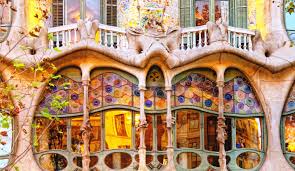
We’ll be staying in the town of Santillano in Cantabria for our cave art exploration. A side trip over to Comillas will allow us to see some of Gaudi’s very first architecture. While Teilhard de Chardin is famous for saying the universe abhors a vacuum, Gaudi believed that nature abhors a straight line. If you can imagine what that does to architecture you can understand how Frank Gehry was chosen to design the Guggenheim Museum.

The Human Evolution Museum in Burgos. Phoenicians, Romans, and Arabs
are some of those who passed through Spain after the Neanderthals.
The archeological site at Atapuercas that
formed the basis for the Human Evolution Museum.
The town of Burgos in the province of Castile and Leon will give us a chance to visit their Human Evolution Museum as well as the archeological dig site where remains of pre-Homo Sapiens have been found. I think you know why we don't have such a museum in the United States. Burgos is also one of the stopping points on the Camino de Santiago (Pilgrimage Way). We hope to at least set a foot on the Camino even though we will not be walking it west to the ocean where St. Andrew's remains are believed to be enshrined in the cathedral.

East of Bilbao

The town and beach of San Sebastian.
After all the dust and bones of the archeological site, we will leave Castile and Leon and return to Basque territory where the coastal town of San Sebastian is said to be one of the most beautiful sites in the world. We will visit the town of Guernica which is famous for Picasso’s painting of the saturation bombing of the village. It is now home to a Peace Museum. We plan a day in Vittoria, a town that has been a leader in eco-friendly urban planning with a section where vehicles are banned.

Vittoria is an hour south of Bilbao.
While much planning has gone into preparing for this rendezvous with history, we are open to being unexpectedly surprised. One never knows when synchronicity will happen and awe will strike. Three years ago I could never have planned to arrive in Palermo, Sicily in time for the amazing Mediterranean exhibition that happened to be showing in the same building as the Palatine Chapel. That synchronicity provided a high point for my travels in Southern Italy.

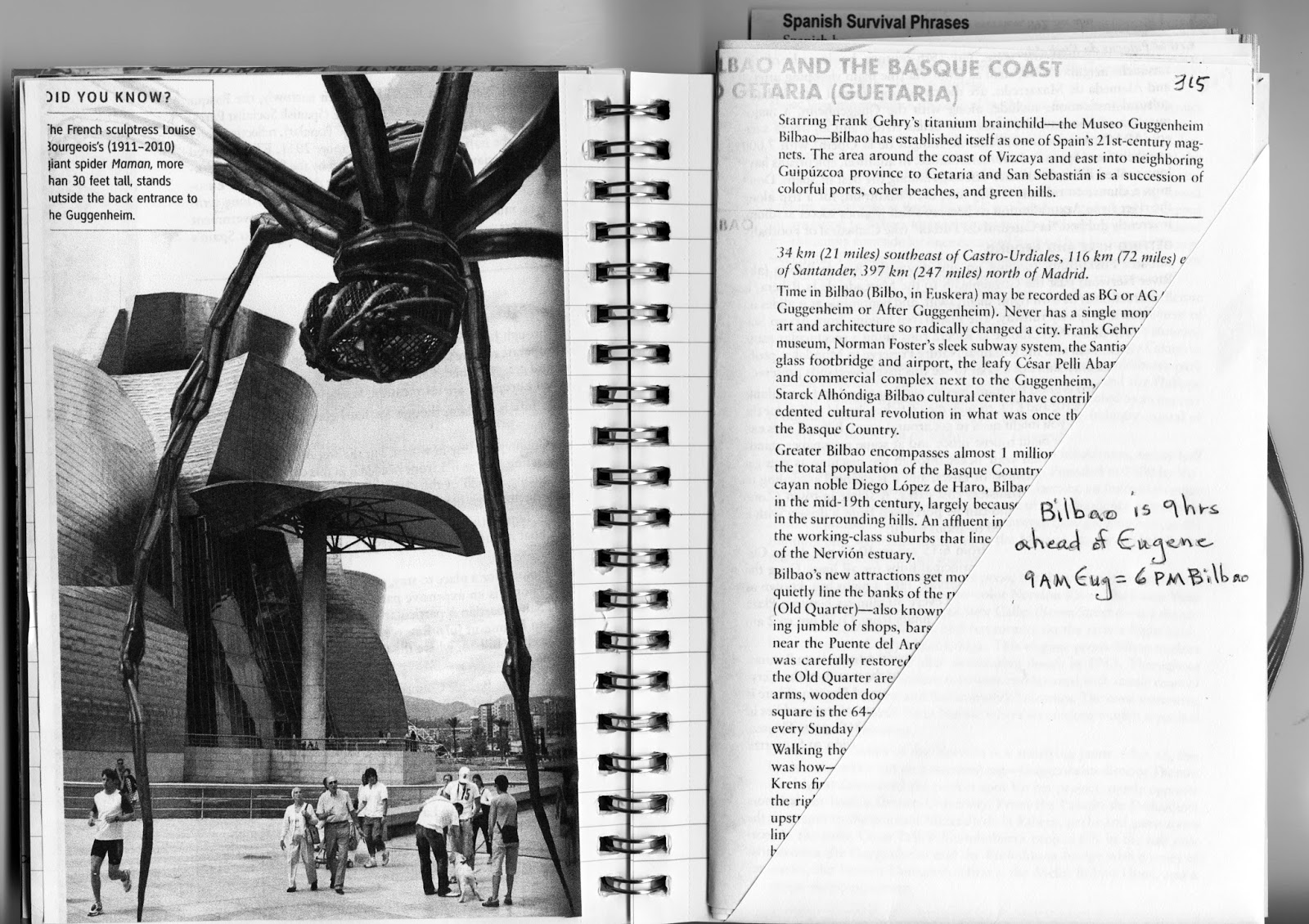
I have made our own tour book for details about accommodations and travel
and with pockets to hold copies of pages from different travel books we have studied.


Monday, August 28, 2017

Mystery of the Rising Sun

Cover of my Ancient Near East sketchbook.

Embracing the Unknown

In the summer of 2013 I brazenly opened a fresh sketchbook and began compiling research notes, images, and ideas for artwork about our human migration from East Africa into the Ancient Near East. I say brazenly because who in their right mind would imagine they could say anything remotely new about the place where western civilization began?

Research on the Ancient Near East occupied summer and fall of 2013. But by winter of 2014 I had to change focus to prepare for a self-portrait show I had entered. The interruption continued as I left my job in June, did a residency in Italy, completed work on Southeast Asia/Oceania, worked on an earlier migration from Africa into Southwest Asia, and created three-dimensional pieces for Africa and Southwest Asia.

As one thing led to another it was fall of 2016 when I re-opened the Ancient Near East sketchbook, reviewed what I had gathered, and made more notes.
Wheel and crescent were emerging as primary symbols.
I was particularly struck by the fact that the wheel was first devised in this region of the world, the region was known as the ‘fertile crescent’, and the earliest name for the region was Levant – meaning ‘The Rising Sun’. I drew a sketch that I called “The Rising’ and determined that it would somehow be a three-dimensional piece for the Ancient Near East.
My initial image for a 3D piece on the Ancient Near East.
I remembered a sculpture I had seen in a magazine. It was composed of two metal bars with profile images atop. The lower parts of the bars crossed in the middle to make it stand upright. I thought maybe I could create something similar out of foam core. I found a photo of the sculpture and placed it in my sketchbook.

Mea culpa: I did not record the title of this piece or the name of the sculptor.
In February of 2017 I drew my sketch to the size that I thought I wanted the sculpture to be, planning to use this drawing to make pieces to size. I contemplated how high the base bars should be and how high the images would be. I listed possible images to go on the crossbars: crescent shaped stone knife, Goddess figurine, bull, goat, herder, etc. I did a mock-up of ‘The Rising’ using foam core and watercolor paper.

Scale drawing of anticipated pedestal sculpture of The Rising.
My first mock-up using foam core and watercolor paper.
At this point I recalled how difficult it is to cut foam core at an angle. I realized I was not adept enough to create beautiful work. I would have to find another way to make this image. Facing the unknown brought to mind Nancy Drew mystery stories.

Nancy Drew Adventures

As a girl, curled up on the radiator in my bedroom, I read all of the Nancy Drew mysteries. I became aware of Nancy Drew as an archetype in my psyche in mid-life. I was leaving a thirty-year career as a global social activist to become an independent Shiatsu therapist and write a book. I had packed my meager goods and shipped them from Belgium to a friend’s home in Oregon. I had changed my name and visited my daughter in Boston. Aware that I had no clue what I was doing, I had opted to take the train across country so I would have time to put things in perspective.  

Boarding the train in Boston, anxiety burst into full bloom. Tears flowed over the loss of my established identity and the knowledge that my daughter and her fiancé were not moving to the west coast after all. Wet and crumpled Kleenex made a small mountain on the tray before me. Philadelphia and Chicago rolled by and then wide expanses of land and sky came into view. I attempted to calm myself by writing in my journal, scribbling one fear after another. Desperately I began pulling reflective tools out of my memory to tamp down my fears: timelines, strategic planning, mind-maps.

I made a mind-map of all the unknowns I faced. That’s when Nancy Drew appeared. By the time I was met at the train station in Portland, Oregon, I had determined that I had three mysteries to solve: Where on the west coast would I settle? Once location was determined, where in that place would I live and work? And finally, how would I create and build a Shiatsu practice? If Nancy Drew taught me anything, it was that unknowns are not a threat; they are the beginning of a new adventure.

"Don't panic," I told myself. "The Rising is a grand mystery to be solved."

Maybe Wooden Hoops

My adductor strain in mid-April put creative work on hold for a while but by mid-June I was back in the studio and ready to try another way of making a three-dimensional form of The Rising. With a vague idea of maybe finding a wooden embroidery hoop to use for a sun or wheel, I headed to JoAnne's where materials tend to spark my imagination. The hoops I saw were not the right size and did not speak to me but I was drawn to 18" wire wreath forms. I found some decorative tapes that I thought might be of use in turning a wreath into a sun.

Wire wreath wrapped with tape - initial idea for a 'rising sun' image.

I found some gold and copper adhesive paper that I bought just because the shiny colors spoke to me of the sun. I spotted some 16" cardboard cake holders and got them in case the wreath form didn't work out. Wood was still on my mind so I went to Woodcraft where I found some tubular wood about one fourth inch in diameter. It's used for cane-bottomed chairs.

I had in mind using raffia to make sun rays coming out from the wreath form. 
I spent several days wrapping tape around the wreath form and imagined using raffia to suggest rays of the sun. Next I traced and cut out two crescent forms from matte board. They would fit back to back. I covered them with gold and copper adhesive paper.

I had the idea that I could mount the crescent form on the wreath sun with sticks of balsa wood left over from when I made the Ecosystems Stick Chart for Oceania. I figured out how to make a cross bar by joining two together. The cross bar would be on the back of the crescent and attach to the wreath sun. However, when I began wrapping the longer stick with yellow raffia, the stick broke. I decided the pressure of wrapping raffia was too much for the balsa wood so switched to the idea of painting the sticks, either copper or orange.

Broken cross bar and two other attempts.
About this time I was nearing completion of the six boards that comprise the Ancient Near East painting. I decided to invite a perceptive friend over to have a look. She took one look at what I had for The Rising and said, "LiDoña, you can't use a cross. It would be offensive to non-Christians." I asked, "Even if they are asymmetrical? It is just to attach the sun and crescent together."

She was adamant. "Doesn't matter, I don't think you should risk it." Of course she was correct. But it meant that this three-dimensional piece called The Rising was still a mystery.

What if?

As I continued working on the six Ancient Near East boards I fretted and stewed for a couple of weeks. I tried to imagine another way to attach the sun and crescent. Could I hang them from a hanger? Nope, looks weird and clumsy.

One morning I walked into the studio and seeing my wreath sun hanging on the wall, I found myself wondering, "What if this is not the sun but instead is a base from which sun, crescent, and wheel were suspended?"

One 'what if' unleashed others. What if I made a wheel out of one of the cardboard cake holders? What if I wrapped it with raffia to give it texture?

Cardboard cake holder with copper adhesive paper and raffia.
What if I used the wooden loops from Woodcraft to make the rising and setting sun? Since the wood is stronger than balsa, what if I wrapped them with the raffia I was going to use for the rays of the sun?

Permutations of the sun.
Wrapping raffia is a time-consuming task. But I was so pleased with my wheel that I took a deep breathe and went on to wrapping the three wooden loops I'd gotten at Woodcraft.

On the Independence day weekend I attended Art and the Vineyard with a friend. One booth had some hanging bead strings. I asked the artist what she was using for the hanging material. It was plastic coated wire used in jewelry making. She talked about crimping the wire ends together and said, "It's so easy." "Oh yeah, I thought. Easy when you've done it several dozen times."

Nevertheless I was convinced that this would be the best way to suspend the mobile and its pieces so back I went to JoAnne's to get wire, crimps, and a crimping tool. But none of these had directions for how you crimp. I hemmed and hawed for a couple of weeks until it occurred to me to look for a video on You Tube. Sure enough there was one that gave me the basics. So I went up to the studio to practice before making hanging wires for the base and the three objects.

I used two differently sized sets of letters to identify
contemporary countries that made up the ancient near east.
I have always been fascinated by kinetic sculptures. I am mesmerized by the way pieces move gently in relation to the flow of air. In this case, I also delight in the moving shadows cast by the sculpture. The mystery precipitated by a sketch in summer of 2013 came to resolution in summer 2017. It turned out to be an adventure in materials with Nancy Drew and JoAnne's playing the major parts.

Shadows cast by The Rising's moving parts remind us
that this region of the world has always affected other places.