Tuesday, September 26, 2017

Anticipating Spain

Guernica by Pablo Picasso
Arriving two hours apart at the airport in Bilbao in mid-October, my friend Karen and I will begin a two-week adventure in Northern Spain. We will be investigating Basque culture in the province of Pais Vasco, cave art in Cantabria, and evolution in Castile/Leon. With its now-famous Guggenheim Museum, Bilbao will be our base. We will make trips west for most of my picks (ancient evolutionary remains and cave art) and east for most of Karen’s picks (contemporary Basque culture and cuisine).

Guggenheim Museum in Bilbao designed by Frank Gehry.
Because we will be traveling in less urban areas, we’ve been boning up on Spanish through the use of the Pimsleur audio method of language acquisition. This being my first time to learn Spanish, my goal of mastering Spanish 1 will, hopefully, allow me to show respect for another culture. My daily 30-minute lesson right after lunch has become a sort of game as I enjoy the auditory puzzles it presents. Karen has studied Spanish before so she set a goal of mastering Spanish 2. We will be relying on her ability to read Spanish to get us on the right trains and buses.

West of Bilbao

Upon seeing the cave art at Altamira, Picasso exclaimed
that artists have achieved nothing since then.
Seeing cave art at Altamira and in other near-by caves in the province of Cantabria has long been a goal of mine. My paternal ancestral journey followed the northern edge of the Mediterranean Sea and spent time in the Iberian Peninsula during one of the last ice ages. Also this pre-agricultural site allows me to prepare for creating the Northern European section of my project tracing our human migrations from East Africa to all parts of the world.

Karen and I recommend the film Finding Altamira for some historical perspective on how professional hubris can get in the way of authentic knowledge.

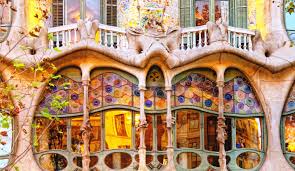
Gaudi's architecture has given us the derogatory term'gaudy' that completely misses the point of his revolutionary concepts.

I think we will see this in Comillas.
We’ll be staying in the town of Santillano in Cantabria for our cave art exploration. A side trip over to Comillas will allow us to see some of Gaudi’s very first architecture. While Teilhard de Chardin is famous for saying the universe abhors a vacuum, Gaudi believed that nature abhors a straight line. If you can imagine what that does to architecture you can understand how Frank Gehry was chosen to design the Guggenheim Museum.

The Human Evolution Museum in Burgos. Phoenicians, Romans, and Arabs
are some of those who passed through Spain after the Neanderthals.
The archeological site at Atapuercas that
formed the basis for the Human Evolution Museum.
The town of Burgos in the province of Castile and Leon will give us a chance to visit their Human Evolution Museum as well as the archeological dig site where remains of pre-Homo Sapiens have been found. I think you know why we don't have such a museum in the United States. Burgos is also one of the stopping points on the Camino de Santiago (Pilgrimage Way). We hope to at least set a foot on the Camino even though we will not be walking it west to the ocean where St. Andrew's remains are believed to be enshrined in the cathedral.

East of Bilbao

The town and beach of San Sebastian.
After all the dust and bones of the archeological site, we will leave Castile and Leon and return to Basque territory where the coastal town of San Sebastian is said to be one of the most beautiful sites in the world. We will visit the town of Guernica which is famous for Picasso’s painting of the saturation bombing of the village. It is now home to a Peace Museum. We plan a day in Vittoria, a town that has been a leader in eco-friendly urban planning with a section where vehicles are banned.

Vittoria is an hour south of Bilbao.
While much planning has gone into preparing for this rendezvous with history, we are open to being unexpectedly surprised. One never knows when synchronicity will happen and awe will strike. Three years ago I could never have planned to arrive in Palermo, Sicily in time for the amazing Mediterranean exhibition that happened to be showing in the same building as the Palatine Chapel. That synchronicity provided a high point for my travels in Southern Italy.

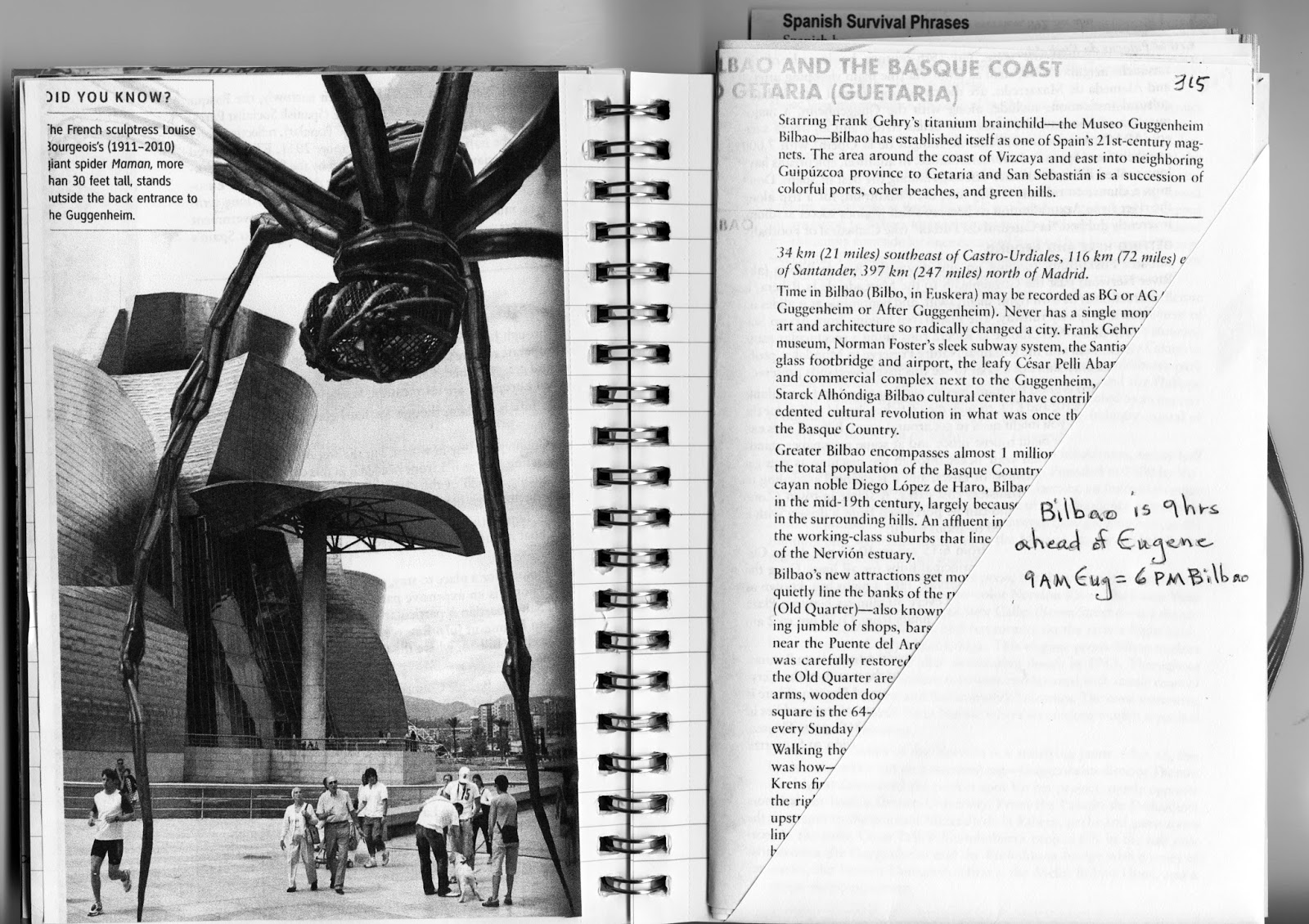
I have made our own tour book for details about accommodations and travel
and with pockets to hold copies of pages from different travel books we have studied.


Monday, August 28, 2017

Mystery of the Rising Sun

Cover of my Ancient Near East sketchbook.

Embracing the Unknown

In the summer of 2013 I brazenly opened a fresh sketchbook and began compiling research notes, images, and ideas for artwork about our human migration from East Africa into the Ancient Near East. I say brazenly because who in their right mind would imagine they could say anything remotely new about the place where western civilization began?

Research on the Ancient Near East occupied summer and fall of 2013. But by winter of 2014 I had to change focus to prepare for a self-portrait show I had entered. The interruption continued as I left my job in June, did a residency in Italy, completed work on Southeast Asia/Oceania, worked on an earlier migration from Africa into Southwest Asia, and created three-dimensional pieces for Africa and Southwest Asia.

As one thing led to another it was fall of 2016 when I re-opened the Ancient Near East sketchbook, reviewed what I had gathered, and made more notes.
Wheel and crescent were emerging as primary symbols.
I was particularly struck by the fact that the wheel was first devised in this region of the world, the region was known as the ‘fertile crescent’, and the earliest name for the region was Levant – meaning ‘The Rising Sun’. I drew a sketch that I called “The Rising’ and determined that it would somehow be a three-dimensional piece for the Ancient Near East.
My initial image for a 3D piece on the Ancient Near East.
I remembered a sculpture I had seen in a magazine. It was composed of two metal bars with profile images atop. The lower parts of the bars crossed in the middle to make it stand upright. I thought maybe I could create something similar out of foam core. I found a photo of the sculpture and placed it in my sketchbook.

Mea culpa: I did not record the title of this piece or the name of the sculptor.
In February of 2017 I drew my sketch to the size that I thought I wanted the sculpture to be, planning to use this drawing to make pieces to size. I contemplated how high the base bars should be and how high the images would be. I listed possible images to go on the crossbars: crescent shaped stone knife, Goddess figurine, bull, goat, herder, etc. I did a mock-up of ‘The Rising’ using foam core and watercolor paper.

Scale drawing of anticipated pedestal sculpture of The Rising.
My first mock-up using foam core and watercolor paper.
At this point I recalled how difficult it is to cut foam core at an angle. I realized I was not adept enough to create beautiful work. I would have to find another way to make this image. Facing the unknown brought to mind Nancy Drew mystery stories.

Nancy Drew Adventures

As a girl, curled up on the radiator in my bedroom, I read all of the Nancy Drew mysteries. I became aware of Nancy Drew as an archetype in my psyche in mid-life. I was leaving a thirty-year career as a global social activist to become an independent Shiatsu therapist and write a book. I had packed my meager goods and shipped them from Belgium to a friend’s home in Oregon. I had changed my name and visited my daughter in Boston. Aware that I had no clue what I was doing, I had opted to take the train across country so I would have time to put things in perspective.  

Boarding the train in Boston, anxiety burst into full bloom. Tears flowed over the loss of my established identity and the knowledge that my daughter and her fiancĂ© were not moving to the west coast after all. Wet and crumpled Kleenex made a small mountain on the tray before me. Philadelphia and Chicago rolled by and then wide expanses of land and sky came into view. I attempted to calm myself by writing in my journal, scribbling one fear after another. Desperately I began pulling reflective tools out of my memory to tamp down my fears: timelines, strategic planning, mind-maps.

I made a mind-map of all the unknowns I faced. That’s when Nancy Drew appeared. By the time I was met at the train station in Portland, Oregon, I had determined that I had three mysteries to solve: Where on the west coast would I settle? Once location was determined, where in that place would I live and work? And finally, how would I create and build a Shiatsu practice? If Nancy Drew taught me anything, it was that unknowns are not a threat; they are the beginning of a new adventure.

"Don't panic," I told myself. "The Rising is a grand mystery to be solved."

Maybe Wooden Hoops

My adductor strain in mid-April put creative work on hold for a while but by mid-June I was back in the studio and ready to try another way of making a three-dimensional form of The Rising. With a vague idea of maybe finding a wooden embroidery hoop to use for a sun or wheel, I headed to JoAnne's where materials tend to spark my imagination. The hoops I saw were not the right size and did not speak to me but I was drawn to 18" wire wreath forms. I found some decorative tapes that I thought might be of use in turning a wreath into a sun.

Wire wreath wrapped with tape - initial idea for a 'rising sun' image.

I found some gold and copper adhesive paper that I bought just because the shiny colors spoke to me of the sun. I spotted some 16" cardboard cake holders and got them in case the wreath form didn't work out. Wood was still on my mind so I went to Woodcraft where I found some tubular wood about one fourth inch in diameter. It's used for cane-bottomed chairs.

I had in mind using raffia to make sun rays coming out from the wreath form. 
I spent several days wrapping tape around the wreath form and imagined using raffia to suggest rays of the sun. Next I traced and cut out two crescent forms from matte board. They would fit back to back. I covered them with gold and copper adhesive paper.

I had the idea that I could mount the crescent form on the wreath sun with sticks of balsa wood left over from when I made the Ecosystems Stick Chart for Oceania. I figured out how to make a cross bar by joining two together. The cross bar would be on the back of the crescent and attach to the wreath sun. However, when I began wrapping the longer stick with yellow raffia, the stick broke. I decided the pressure of wrapping raffia was too much for the balsa wood so switched to the idea of painting the sticks, either copper or orange.

Broken cross bar and two other attempts.
About this time I was nearing completion of the six boards that comprise the Ancient Near East painting. I decided to invite a perceptive friend over to have a look. She took one look at what I had for The Rising and said, "LiDoña, you can't use a cross. It would be offensive to non-Christians." I asked, "Even if they are asymmetrical? It is just to attach the sun and crescent together."

She was adamant. "Doesn't matter, I don't think you should risk it." Of course she was correct. But it meant that this three-dimensional piece called The Rising was still a mystery.

What if?

As I continued working on the six Ancient Near East boards I fretted and stewed for a couple of weeks. I tried to imagine another way to attach the sun and crescent. Could I hang them from a hanger? Nope, looks weird and clumsy.

One morning I walked into the studio and seeing my wreath sun hanging on the wall, I found myself wondering, "What if this is not the sun but instead is a base from which sun, crescent, and wheel were suspended?"

One 'what if' unleashed others. What if I made a wheel out of one of the cardboard cake holders? What if I wrapped it with raffia to give it texture?

Cardboard cake holder with copper adhesive paper and raffia.
What if I used the wooden loops from Woodcraft to make the rising and setting sun? Since the wood is stronger than balsa, what if I wrapped them with the raffia I was going to use for the rays of the sun?

Permutations of the sun.
Wrapping raffia is a time-consuming task. But I was so pleased with my wheel that I took a deep breathe and went on to wrapping the three wooden loops I'd gotten at Woodcraft.

On the Independence day weekend I attended Art and the Vineyard with a friend. One booth had some hanging bead strings. I asked the artist what she was using for the hanging material. It was plastic coated wire used in jewelry making. She talked about crimping the wire ends together and said, "It's so easy." "Oh yeah, I thought. Easy when you've done it several dozen times."

Nevertheless I was convinced that this would be the best way to suspend the mobile and its pieces so back I went to JoAnne's to get wire, crimps, and a crimping tool. But none of these had directions for how you crimp. I hemmed and hawed for a couple of weeks until it occurred to me to look for a video on You Tube. Sure enough there was one that gave me the basics. So I went up to the studio to practice before making hanging wires for the base and the three objects.

I used two differently sized sets of letters to identify
contemporary countries that made up the ancient near east.
I have always been fascinated by kinetic sculptures. I am mesmerized by the way pieces move gently in relation to the flow of air. In this case, I also delight in the moving shadows cast by the sculpture. The mystery precipitated by a sketch in summer of 2013 came to resolution in summer 2017. It turned out to be an adventure in materials with Nancy Drew and JoAnne's playing the major parts.

Shadows cast by The Rising's moving parts remind us
that this region of the world has always affected other places.


Sunday, July 30, 2017

Maiden Migrations Exhibition


I'm moving toward completing section one of Eve's Imprint, my large project tracing our human migrations from East Africa to all parts of the world. Maiden Migrations includes our African Origins, the initial coastal migration into Southwest Asia, the first land-based migration into the Ancient Near East, the continued coastal migration into Southeast Asia and later Oceania, and my own ancestral journey.

Recently I finished the six paintings that make up the Ancient Near East. While they were at the photographer's, I worked on a 3D piece that has gone through several permutations. This is my third attempt to express some of the history of this amazing part of the world in a three dimensional piece. Below are some pieces that I hope will come together to make a hanging stabile called The Rising.


The wheel was invented in the Ancient Near East. I made this one
from cutting a cardboard cake holder and wrapping it with raffia.

An early name for this region of the world was Levant, meaning
'The Rising'. I hope these raffia wrapped wooden hoops suggest
the sun rising over the land.

The Ancient Near East was also known as the Fertile Crescent.
With this I am suggesting how Egypt, Levant (Israel, Jordan, Lebanon, and Syria),
Arabia, Iraq, Iran, and Turkey are still a crescent. I'm still working on this piece.
This hoop will hang horizontally and the other three items
will hang from it - if all goes according to plan!
In anticipation of making digital exhibition proposal submissions, I have been busy updating my  website and creating a section for Maiden Migrations. I invite you to explore my updated LiDoña Wagner website (www.lidonawagner.com) - you can click on the link to the right - and in particular the Maiden Migrations section. I hope you will be my proofreaders and critics. I look forward to hearing from you.

Friday, June 30, 2017

Japanese Cows, A Lebanese Web Designer and You

The Great Wave off Kanagawa by Hokusai, 19th century

Accelerating Technology: Sensors Are Censuring You

Where were you in 2007? That’s the year that technology began accelerating beyond belief. That acceleration has continued unabated and will continue to do so. While some people have benefited from technology’s expansive growth wave, it has also left hundreds of thousands of people stranded in its wake. Are you riding the technology wave or struggling in its wake?

As technology expanded its reach Japanese dairy farmers went to a high tech firm and asked them, “How can you help us manage our dairy cows?” The techies put a pedometer on the leg of each cow that connected to the farm by radio signal. Analysis showed that as a cow was going into heat (the prime time to do artificial insemination) its steps speeded up. By connecting the cows’ sensors to a monitor, a dairy farmer was able to know exactly when to do artificial insemination with each cow. Similarly in upper New York state dairy farmers now use sensory monitors for electronic milking.

Think about the implications. Every time you click a button on your computer or smart phone, it is fed into a retrieval system that then uses algorithms to mine ‘big data’ to discern small and large trends. One result we have all experienced is being bombarded by unwanted advertisements. But look at it another way. Since a large proportion of mass media and large wealthy corporations are owned and operated by conservatives, all of your data (clicks) is used to determine what messages will attract your support. Then wealthy conservatives pour money into media ads that push viewers toward their point of view.  Ever wondered why and how these ads are timed to destroy progressive candidates?

If you have read Thomas Friedman’s Thank You for Being Late, you know the cow examples come from the first section where he describes three compounding accelerations that are driving humans past the point of being able to adapt. The three he names are technology, climate change, and globalization of the economy.

Multi-Cultural Goddess by LiDoña Wagner
How many sensors are tracking your preferences?

Innovators Addressing Accelerating Climate Change

While incredible advances have been made in forms of clean energy (solar, wind, water, wave, etc.) the continued use of fossil fuels and the rapid expansion of human populations are still outstripping the earth’s capacity to absorb carbon. The Paris Accord was a giant step forward in global commitment to reversing this equation.

Fossil fuel industries, climate change deniers and the Dumpster may have their heads in the sand but leaders in over a hundred cities have committed to reaching US agreements in the Paris Accord. All of the states on the west coast, cities across the Midwest and South, and many Atlantic states have joined under Michael Bloomberg’s leadership to carry forward US carbon reduction commitments and have arranged to report to the United Nations on honoring the US commitment. And just this week over 1400 mayors in the United Sates Conference of Mayors passed a unanimous resolution committing to 100% clean, renewable energy. This reminds me of Margaret Mead’s comment. To paraphrase: Never doubt that a small group of committed people can change the course of history. 

Friedman notes that with the independence and diversity of its cities and states, the United States is in a great position to launch a multitude of innovations that can address the trinity of compounding accelerations shaking today’s world. It is therefore intriguing to see that Bloomberg’s philanthropic foundation has committed $270 million dollars to city mayors who present inventive city policies that address climate change, education, and the opioid epidemic.

Bloomberg himself is an interesting example of the constant reinvention that today’s rapid changes require. He began as a Democrat but then reinvented himself as a Republican to run for office, and after recognizing the obsolescence of political parties he now identifies as an Independent. Obviously he believes in doing whatever it takes to address critical issues.

Birthplace of Human Technology by LiDoña Wagner
Population explosions in Africa and the Middle East are fueling instability
and unrest that make it difficult to navigate contemporary changes.
Climate change is exacerbated by the rapid expansion of human population that is overburdening earth’s systems. Countries in the industrialized world have brought down population growth significantly. But in Africa and the Middle East, where girls are denied education and women remain illiterate, population rates soar. These regions are producing a time bomb of young people who will be unable to find work and the means of survival.

It has been shown over and over again that the surest way to address population explosions is through the education of girls and women. The Malala Fund is a girls’ education program launched by the Nobel Peace Prize winning young Pakistani girl who recovered from being shot in the head by the Taliban. The Central Asia Institute has been building schools to educate girls in Afghanistan, Pakistan, and Tajikistan for over twenty years. Let Girls Learn is an educational initiative in Africa launched by Michelle Obama. You can put your finger in the dike holding back the population bomb by supporting any of these efforts.

Silk Road Trade by LiDoña Wagner
We've come a long way from transporting and trading necessary salt,
other spices and luxuries such as silk by camel across deserts and mountains. 

Live to Learn and Learn to Live

The American 'high-wages with low skills' era of post World War II is over and will not return. As Europe and Asia have rebuilt their economies, the United States' advantage has evaporated. Isolation and trade barriers will not stop the advancing global market; they will simply give other countries greater economic advantage. Whether it is an American, Chinese, Korean, European or any other large corporation, such entities will search the world to find the well-trained workers they need.

Like it or not, every worker is in competition not with his or her neighbor but with the most aspiring, committed, and skilled worker somewhere on the planet. Friedman gives the example of a graphic designer in Lebanon who understands her place in the global market. She upped her skills by taking an online web-design course. That certificate opened the door to having web-design clients all over the world. She did not sit on her hands waiting for a job to come to her; she invented her own job.

To participate in the world of today and tomorrow, one must be a lifelong learner. A young person anywhere in the world must learn how to learn and to innovate in order to forge a place for him or her self. The most altruistic companies give their workers opportunities to improve their skills, on their own time. This makes the growing edge of education that of online learning.

Robots and immigrants are not taking jobs away from unskilled white males in America. Rather an attitude of entitlement, a fear of learning new skills, and a rejection of global realities places dramatic limits on any person’s future. A job is not waiting for you; you must create it yourself. The choice of whether to be a dinosaur of the past or a lifelong learner and innovator belongs to everyone.

Paddling With the Current

How does any person navigate these three accelerating global trends: technology, climate change, and globalization? Friedman gives the example of how to manage a kayak going through rapid currents. Don’t take your paddle out of the water and don’t try to stop the kayak. Paddle as fast as the current is going so you can ride with it!

For me technology is the biggest challenge. I have been working on education of girls and women my whole life and on environmental sustainability since 1972 and I will continue to do so. As a lifelong learner and innovator, there will always be a place for me in the global market. Where I am a danger to society is in being reluctant to learn new technology. If I can combine my preference for human interaction with learning to partner with artificial intelligence perhaps I can help others navigate the waves of change that define our era.

Unable to find a photo of me kayaking, I took this one from Google images.
You can bet his arms got tired, but he made it safely through the rapids.

Saturday, May 27, 2017

Who Represents the Future?

Ballad of Shard and Bone by LiDoña Wagner

Acknowledging An Aging Body 

Since I've been doing yoga for fifteen years, I saw no problem in attending a yoga class - for young people. I was pretty much keeping up until, getting into half-moon pose, I noticed that the instructor was coming around correcting student poses. Instinctively, I threw back my extended back leg to auto-correct my pose. Ohhh … owwww!

Assuming that athletes are always pushing an edge, next day I ignored the discomfort in my groin and walked three painful miles. Returning home, I went online to find advice on healing groin injuries. I got the recommended walking stick and attempted to keep up with my normal schedule. After walking another three excruciating miles the following weekend, reality crashed through my resistance. A doctor appointment got me a referral to a physical therapist.

“Stop what you’re doing and REST,” said my newly minted physical therapist. “You have an injured adductor muscle and it will require a 12-week healing process.” 12 weeks!!!!  “From the initial injury or from the last re-injury?” I queried. “The last re-injury,” she said firmly.

By our second session she had me figured out. “Resting does NOT mean walking. It means lying down, maybe some sitting, icing, and a few gentle knee drops. It means not going up and down the stairs more than three times a day.”

Self-Imposed Exile 

Ok, I get it. If I do not want to permanently disable myself, I will have to go into self-imposed exile and REST. I cancelled everything except home-based teaching and mentoring sessions and began cultivating an intimate relationship with the floor. How many postures do you think there are for icing and reading at the same time?

How oral cultures memorize
extraordinary amounts of information.
In the midst of ‘forced rest’ I had a book going upstairs and one going downstairs. Downstairs I read The Memory Code and upstairs I reread Clan of the Cave Bear, a classic from 1980. The Memory Code is about methods used by oral cultures to memorize vast amounts of knowledge. Clan of the Cave Bear is about pre-verbal Neanderthals picking up, raising, and caring for a Homo sapiens child, Ayla. Reading the books simultaneously was amazing.

Yes, Neanderthals and Homo sapiens did interact.
Coming back to Clan of the Cave Bear thirty-seven years after the first time, I found it just as riveting and moving. But there was a difference. While I still identified with the challenges Ayla faced for being different, this time I was no longer involved in a patriarchal organization similar to the clan of the cave bear. I was able to get a bit of distance on my feelings and look at the book analytically.

In reading the description of the book’s author, Jean Auel, I was struck by the fact that she had an MBA and asked myself how this affected her writing. I realized her MBA experience meant she was able to provide clear examples of four different styles of leadership.

Encrustations of Time by LiDoña Wagner

Leadership Styles

Clan leader Brun was a sensitive and responsive executive who sought the involvement of his people when making decisions that would impact the clan’s future. He was able to step back and get an overview. He found ways for the clan to accommodate Ayla’s differentness. Too late, he realized that his son was unable to lead the clan.

Bear Medicine by LiDoña Wagner
Medicine Woman Iza was a compassionate maternal healer and teacher. She cared about giving Ayla a viable future in spite of the clan’s tendency to dismiss and alienate her. Born of another species of hominids, she transcended her own heritage and saw Ayla as her ‘true daughter’ who would carry forward her line of great healers.

Shaman Invoking Wisdom by LiDoña Wagner
Spiritual leader Creb was forced to balance a paternal-like love for Ayla with responsibility for the wellbeing of the clan. Disfigured and deformed, he understood Ayla’s predicament. With his capacity to meditate deeply he could see that Ayla represented the future and the clan did not.

Arrogant and self-centered Broud, son of Brun and thus future leader of the clan hated and abused Ayla. He thought only of himself and his desire to be the center of attention. He represented the autocratic leader and the dark side of the clan hierarchy that would lead to its demise.

Once I saw Clan as a representation of leadership styles, I began to make some contemporary comparisons. Barack Obama was one of the wisest and most compassionate leaders in American history. He took the long view and set in motion solutions to long-range problems. Michelle Obama used her maternal nature to bring healthy food and exercise to neglected populations. Pope Francis understands his responsibility for laying a path into a transformed world. I think it is clear that the Dumpster is the dark side of America that wreaks needless destruction in his need to be the center of attention.

Maiden Mother Crone by LiDoña Wagner
So where and who is Ayla? Who represents the unfolding future for our planet? Who brings us new ways of seeing reality and solving problems? Who sees the dark side but refuses to give in to it? Who has the courage to resist the powers of darkness?