Friday, September 28, 2018

Completing Our 2017-18 Mandala Journey

Melody Carr


Melody brought her skills as a poet, gardener, and photographer to her mandala journey. From these she developed a distinctive ‘Folk Art’ style that reflects her strength of character and grounding in reality. As she began the mandala she was at a major life turning point. Thoughout our journey together she reassessed where she had come from and dreamed of where she wanted to go. 

Melody’s Story

I am a woman who

is walking onward, though there are no paths
who is swimming to the island of my soul
who is watching the mountain’s stillness
who is opening her heart and pulling all the bandages off
who is dancing in the fires of the people
who sings walking the hills in the autumn of time
who comes through the cataclysm
who is the spirit held in glass and the reflections of sacred forms
who is outlasting tragedy and violence all around
who is companioned by the spirit of the cyclone
who floats in dark waters 
and exhales her troubles.

Janet Asman


Janet was a clothing designer before becoming a realtor. She brought her highly developed sense of color and design to painting her mandala. Taking pride in all that she does, she worked with commitment toward giving her mandala a sense of completeness. Her mandala reflects a sense of fulfillment and accomplishment.

Janet’s Colors

The four main colors I see when looking at my mandala are blues, greens, whites, and golds. To me the blues and greens represent peace and calm, growth and earth. The whites and creams feel like spirit and the light, purity. The golds feel like wealth of spirit and the imprinted potential for wholeness. Gold balances out the colors. All the colors represent richness of spirit and the presence of grace. In my life I have always had a clear connection with spirit. I knew I wanted my mandala to reflect that connection. I have to feel peace in my existence along with inspiration and grace. This is the level I strive to operate on and to learn from.

Janet’s Journey

Janet chose to tell her story through creating a slide show of her step by step process. Click below to enjoy viewing her journey.


Hope Lewis


This was Hope's fourth mandala. She is a poet, quilter, gardener, and family matriarch with years of experience in doing dream work. Each mandala reflects her experiences expanding awareness and unique pointillist style. 

Worm and Snakes in Hope’s Mandala

Worm. Life reborn from corruption. Human race derived from the worm. Worm marks the stage preceding dissolution and decomposition. Points the way leading up from the primordial energy to life. Transformation and transition to a higher state. Passage of earth to light/death to life. Larval state to spiritual release. Snake. Mankind and snakes opposites. Serpent in all humans. Have no control. Lower psyche. What is unusual, incomprehensible and mysterious. Snake shocks the spirit. Snake a line that goes into infinity. Sacred made manifest. Old God. Dual symbol of soul and libido. Cosmic serpent bites its tail.


Hope’s Story


This is the story of a woman who remembers her inner child and loves her and has watched her grow into an older soul. Having gone through many life experiences, she realizes the mystery of lie is a journey to the center of all things, a journey to oneness with all things. Sitting in nothingness is sitting in all things. A paradox indeed. A mystery indeed. 

Opening to the dream world, to the symbolic world, has brought me to this oneness. This ever expanding view will continue I hope until she disappears exactly how she appeared 73 years ago. This journey is an alleluia experience if one can move forward knowing one is never alone while moving closer and closer to the unknown that somehow we sense to be present. This is the story of a woman who finds peace in knowing all is as it should be even in the worst of times, even when the mystery refuses to show itself. 

LiDoña Wagner
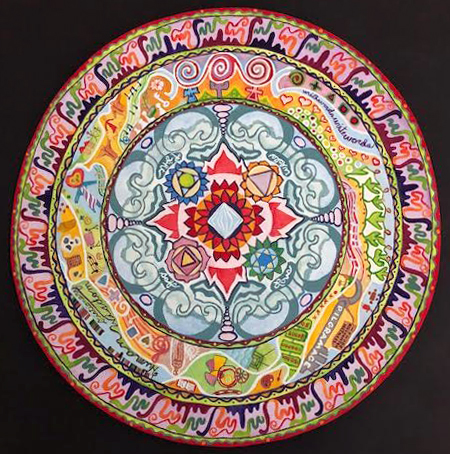

I was introduced to mandalas by Carl Jung over thirty years ago and have been drawing and painting mandalas ever since. After studying with Madeleine Shields in Victoria, British Columbia, I took what I knew about dream work, journal writing, meditation, creativity, and personal growth and designed a Dream Mandala Journey process using a Tibetan Buddhist structure. I have been taking women on Dream Mandala Journeys for nearly twenty years and every time I learn something new.  

LiDoña’s Story

This is the story of a woman whose natural joie de vie led to a denial that she had become old even as she experienced increasing physical difficulties. The colors in her fire ring expressed her yearning for deeper spirituality.

A year into her mandala journey her health was declining; she finally acknowledged that she was old. Her dream reflections and dialogues told her that the individuation journey was complete and it was time to begin a new journey of learning to express love and compassion. They also reflected her struggle to write the book that would accompany her completed Maiden Migrations installation. 

The color green kept appearing and reappearing, revealing her closeness to nature and her ability to nurture, parent, and protect. Another color, a warm yellowish orange called Gamboge, asserted itself as a powerful metaphor for change and reflected her energetic striving, sense of identity, and healthy assertiveness. This Gamboge color called out to her to recognize a developing sense of a more genuine and personal spirituality. 

As her mandala journey took her to the four portals into the Inner Garden, her diminished health was too blatant to ignore. Her naturopath put her on a diet that revealed her health issue was not arthritis. Her portals announced inner strengths: Root chakra/I am safe. Power chakra/I am whole and perfect. Heart chakra/I love and am loved. Throat chakra/I am light.

Working on the Inner Garden provided peace while she was negotiating a reassessment of her illness. Red is the dominant inner garden color. This color used in ritual celebrations marks an arousal of healing, life-giving potentials deep within the psyche. It also is a sign of progress toward achieving one’s great work. It represents the energy we need to survive, be healthy, and transform ourselves to greater inner wisdom.  

Completing the Inner Garden precipitated creation of a lace-like pattern in the Sea of Life to connect the Inner Garden to the transition ring and dream cycle. Her mandala work provided strength to go to Seattle and arrange for the first exhibition of Maiden Migrations in June of 2019. 

Then the bottom dropped out of her plans for the future as X-rays revealed that something was eating away her right hip bone. A total body scan revealed she had a metastatic bone disease in several bones of her body. More tests. Learning there were no tumors in any major organs was a relief. A bone biopsy gave a definitive diagnosis: metastasis from breast cancer 21 years ago. She learned that this is considered to be a chronic illness for which she will need to have treatment for the rest of her life.

This woman’s Inner Garden takes the shape of a cross, suggesting that she is waging a hero’s battle and may be called upon to endure a period of testing. She is balancing the contradictions that are part of human nature. The garden is filled with flowers  that suggest a growth process unfolding in her relationship to the self. It reveals her soul’s work. 

Wednesday, August 22, 2018

On Becoming Old

The fashionable cane that helps me balance to prevent falling.
I am old. Denial is no longer an option. As I approach the anniversary of my 79th year as a spiritual being having a human experience, my arthritic hip is a constant reminder that one cannot turn back the physical clock.

One would think that earlier brushes with death would have prepared me for the end of life. After all I could have died when:
  • one of two engines failed on a six-seat plane on the way to Timbuktu; or
  •  when our tent collapsed as we set out to march in Selma; or
  • in the Chicago riots after the assassination of Martin Luther King; or
  • on a Filipino bus set fire by protestors; or
  • had my emergency appendectomy in the Philippines been a few hours later; or
  • hitchhiking in Maharastra, India; or
  • when I had breast cancer; or 
  •  of grief when my only child died: or
  • when I hit my head during a fall on the sidewalk in 2015.
But, no. None of those events foretold my struggles with aging. 

The pool where I walk and hang (traction) three times a week to keep my body supple.

Pioneering Meaningful Life

Nor did it help when my physical therapist met my complaint about how much time it takes to care for this aging body with a smiling response. “Isn’t it great that you no longer need to work so you have time to deal with your health issues?” I did not see any great benefit in what she said and while her comment stopped my complaining to her, I continued to rail to myself against what seemed to be outrageous healthcare demands.

What did help was when, after ordering X-rays of the hip, my young physical therapist said, “LiDoña, modern medicine has made it possible for humans to live longer, but the human body was not designed for long life.”

Suddenly, I realized that as baby boomers we are once again pioneering. Now we are leading the charge for living meaningful lives in bodies that are shutting down.


The elaborate bed that enhances circulation in my leg and reading in bed.

Extraordinary Time

Last week three deaths struck me in the heart.
  • My dear friend Gail Katul, who shared my same age, died after a struggle with vascular dementia. She was in my first Eugene Dream Mandala class and was my first local art patron. She was bright, sensitive, creative, and generous.
  •  Aretha Franklyn, Queen of Soul and singer for three presidential inaugurations, died at the same age that I am now. As President Obama said, “she gave us a piece of divinity”.
  • Kofi Annan, the former courageous United Nations General Secretary, passed away just after turning 80. The world lost one of its great peace warriors.
These deaths of persons my age brought to mind something my friend Gordon Harper said after he learned of his diagnosis of Leukemia. “I intend to live this period until my death as EXTRAORDINARY TIME.” And he did.

A similar message is carried in the film The Last Word. Shirley McClain plays a former successful businesswoman facing (and even wanting) death. Yet she decides to make her final months into an extraordinary life - one inspiring others to be their best self.

As you become aware of your human clock ticking down, what kind of extraordinary time will you live?

Saturday, July 28, 2018

Magic of the Mask

Painting of a Stag Shaman in Le Trois Freres cave in France.
Shamanism is thought to be one of the first religions practiced by humans.
Who has not felt the thrill of putting on a mask to become something other than you are otherwise seen to be? Whether it was a Vampire mask for Halloween, a Nefertiti mask for a New Year's Eve party, or makeup for a role in a play, there is something mesmerizing about taking on a different persona. And so it has been for hundreds of thousands of years.

The oldest recorded masks are 40,000-30,000 years old, depicted in Paleolithic cave art. Masks allow us to perform sacred, practical, and playful roles. In the Himalayas they were used as mediators of supernatural forces. Similarly, pictures of shamans in varied cultures reveal the use of masks to shape shift for viewers. 

Tigerman Fight painting in Bhimbetka caves in central India.
In Asia, masked characters usually represent divinities, visages of glory, and are used to ward off evil associated with both the animal and divine worlds. In the United States, Mardi Gras allows mask wearers to play and tell stories. In Oceania, where ancestral worship is prevalent, masks are instruments of revelation, giving form to the sacred. Throughout Europe there are regional folk celebrations that often employ animal masks.

Bird Woman

The magic of the mask was certainly on my mind when I created my five-session creativity workshop; one session was devoted to mask making. With plaster gauze normally used for setting broken bones, participants made a mask of each other’s face and then decorated it to imaginatively depict their inner selves. I got the idea and instructions from Goddesses In Everywoman by Jean Shinoda Bolen.
Joe Bolton - Carved cedar wood Native American mask Haisla, BC
It is my practice to do whatever I ask my students to do. I was living in Victoria, B.C. on Vancouver Island then and one of my favorite Sunday afternoon outings was to visit the Native American art gallery inside the Empress Hotel. They  displayed incredibly beautiful carved traditional masks by First Nations people of the region. Being on an island, water was visible; there were numerous beaches; and seagulls were everywhere. Perhaps it was the combination of all those factors that led me to create a bird mask using sand and sea shells I had collected on a visit to Mexico. I used a white shoestring for the top edging.

LiDoña Wagner Bird Woman Mask 1996
At that time I was aware of the symbolism of the phoenix rising from the ashes and since I had recently left a 30-year career as an international social activist, that felt appropriate. But birds are also seen as linking heaven and earth so in many cultures birds represent the immortal soul. In cave paintings at Altamira they appear to represent the flight of the soul or the spirit flight of a shaman. 

LiDoña Wagner Bird Woman Mask 1996
Although we wore our masks in the final workshop celebration, being shaped to our faces, they were not comfortable. One woman had painted both the inside and outside of her mask so she mounted it on a stick so she could turn it either way. Most of us attached a wire to the back and hung them on our walls.

This Stone mask from 7000 BC may be the oldest in the world.

Sea Nymph

Later, in a workshop in Eugene, Oregon I discovered that I really missed the water that had surrounded me in Victoria. So I decided to marble my mask with sea green and blue paints. I adorned her with a long pale green and white scarf. I called her Sea Nymph.

Everything comes from and returns to the sea. The sea represents the female aspect of the unconscious. It is the place of birth, transformation, death, and rebirth. I was recovering from breast cancer at the time which felt like a brush with death. I had also just learned of my daughter’s melanoma and knew the prognosis was not good. I was hoping that the sea’s representation of the dynamism of life would rescue my daughter. It did not.


LiDoña Wagner transformed Sea Nymph 1998-2017

Transformation

While working on my project of tracing our human migration from East Africa to all parts of the world I sometimes invite a friend to review the work and give me feedback. Captivated by the three-dimensional pieces I was making for each alcove, one such visitor spotted Bird Woman on my studio wall. She asked which alcove this mask would accompany. I told her I had made it twenty years earlier. She was adamant that it belonged in this installation of our global human journey. Oh, really?

I wasn’t sure where Bird Woman belonged but I was pretty sure that Sea Nymph went with her. However Sea Nymph began asking to be transformed. Since she was clearly of the sea, I decided to attach shells to the crown of her head. That did not work. I removed them, leaving a series of holes at the top of the mask.

Sea Nymph looked so plain and nondescript, my next thought was to carve a fish skeleton into one side of her face. The plaster started to crumble when I began cutting. So I just cut out the base form of the fish. This allowed me to create the fish skeleton separately and to make it more durable by applying additional layers of plaster gauze. Since this was a ‘sacred’ fish related to the numinous world of the unconscious, I painted the fish skeleton iridescent pearl. A small turquoise stone I have carried for years seemed an appropriate fish eye.

LiDoña Wagner transformed Sea Nymph 1998-2017
Since ancient humans used animal skins for many purposes, I decided to simply make knots in some white leather cord to fill the holes in her upper forehead. Then I began attaching shells to the area of her ears, also using white leather cord. That seemed to somehow work. I had thought to attach the fish to the nymph mask but nothing I tried seemed right, so I decided to simply hang them together.

LiDoña Wagner Gifts of the Sea assemblage 2017

Gifts of the Sea Assemblage

As I ruminated on the two masks, Bird Woman and Sea Nymph, I felt they needed to be assembled with fishnet. I bought a cotton net bag and cut it apart to resemble netting. I hung the assemblage in an available wall space until I decided it belonged with Southwest Asia. That alcove focuses on the animal life that teemed throughout the world until homo sapiens began to exterminate them and dominate earth. 

While homo sapiens were in the minority, we were keen observers of animal behavior. It was from the predator animals that we learned to kill critters and eat their meat, thus developing a hunter gatherer lifestyle. In many ways homo sapiens identified with the animals they hunted. It was natural for them to perform rituals involving the characteristics of different animals. The use of animal skins and masks impersonating animals enriched their ritual life.

My ongoing research had revealed that ancient humans used to beat bark and make it into cords and ropes. So I added some primitive rope for texture and color. I don't think the position of the rope is quite right yet. I also realize that for exhibition purposes, the assemblage requires a solid backing that can be more easily moved than creating nail configurations in every location. 

A Life’s Work

Frankly, it felt sort of dorky to be including some of my early artwork in this current body of work on our global human journey. But I have come to accept that these early masks are evidence that what I am doing is a life work. My fascination with global cultures, antiquity, communication with the gods, and empowering women are lifelong passions. 


Fang Ngil funeral mask from N. Gabon

Wednesday, June 27, 2018

SOUTHEAST ASIA: Secrets of Angkor Wat

Southeast Asia: Water Is Life by LiDoña Wagner 34"x43"x1.5" 201

Angkor Wat: Sacred Antiquity

The shrieks of monkeys swinging among jungle vines sent shivers along my arms. Elephants that had appeared humungous moments before were mere specks on the surrounding fields below me. Last night’s moonlit Cambodian dancers seemed like a dream. It was 1968. I was climbing the steep staircases to each of three levels of galleries at the temple of Angkor Wat, determined to go to the top of this replica of Mount Meru, home of the gods in Hindu mythology.

Climbing higher and higher, through one narrow temple entrance into yet another smaller and more narrow one, all sense of time and personal identity seemed to drop away. I became an ancient human creature caught in the labyrinth of the mind, trying to give shape and form to its mystery.

Disorientation, not height, was giving me vertigo. The antiquity of Angkor Wat was occasioning something beyond awe. Its bas-relief figures were opening me to a world about which I knew little. I was stunned that a people who had created such a phenomenal culture had just walked away from it and allowed the jungle to take over. Trees growing at the tops of temples had roots that grew down the contours of the temple sides and into the earth beneath. Nature had triumphed over human inventions.

Rivers of Migration by LiDoña Wagner 16"x20"x1.5" 2014
The temples had been overgrown for centuries and were being recovered from the jungle with money and expertise from UNESCO. A small fraction of the temples had been uncovered and were in various stages of restoration. Where jungle growth still had the upper hand, one nearly fainted from a sense of being infinitesimal. Human beings had carved, and carried, and shoved and pushed rocks weighing close to a ton to build these enormous monuments. Then they had vanished and the jungle had claimed back the stones they had used. Once again human beings were scraping away the dirt, fitting the stones together, reassembling a vision of the birth of consciousness. But let them pause too long in weariness or stumble in their task and the vines, trees, monkeys and birds of the jungle would overtake them.

On the ground the elephants were imposing: their slow shifting of weight from one side to the other, enormous buttock, sagging grey skin, floppy ears, sad eyes and endlessly swaying trunks were new to me. I was puzzled by how they continued to thrive while the complex human culture which once occupied this exotic atmosphere had been erased by some unknown tragedy. I wondered at the power of life which their survival shouted at me.

Angkor Wat was the beginning of a life-long love affair with Asia. Herman Hesse wrote that the East is home and that was definitely what I felt as this pre-patriarchal culture filled me with awe and touched layers of my unconscious I had not previously known existed.
  
"The Cambodian people will last forever," smiled our guide. "We are a blend of all the Asian races. We love peace and believe in friendliness."

Unaware of Pol Pot’s killing fields, I believed him. The tumbling stones and insistent jungle pulled me back thousands of years, weaving around me an aura of mystery and beauty. I was in another world.

For three days we walked the wide stone-laid approach roads to the temples, climbed thousands of stone stairs, fingered the stone-carved monkeys, lions, Garuda birds, and listened to the stories of Sita and the gods and goddesses of Asian lore. Two nights we sat in the moonlight and watched the slow foot and finger movements of the Cambodian dancers dressed in cloth of the deepest, richest greens, purples, blues, magentas, their interwoven threads of gold shimmering with each gesture.

"How did it happen? Where did it go?" Over and over my mind chased the elusive thread of history. "How could such creativity, such magnificence, such imagination simply vanish from the earth?”

Himalayas: Water Source by LiDoña Wagner 8"x10"x.75" 2014

End of An Empire: Climate Change and Social Unrest

People had occupied this region of Southeast Asia since 3000 B.C.E. How could the phenomenal Khmer Empire, founded in the 6th century and a major power from the 9th to the 15th century abandon its glorious temple complexes and evaporate as an East Asian power? I am not the only person for whom WHY? and HOW? became obsessive questions.

The ruins of Angkor Wat were apparently found by a Cambodian king while hunting elephants around 1500. Spanish and Portuguese missionaries and Japanese settlers were in the region in the 17th century. Buddhist monks cared for the temples from the 15th to 19th centuries and continue to do so. But it was the 1863 travel notes of  French naturalist Henri Mouhot of his 1860 visit to Angkor Wat that brought global awareness of the these mind-blowing ruins and ignited scientific inquires.

Archeologists, anthropologists, biologists, and later climate scientists flocked to these majestic ruins in search of answers to our unsettling questions. Archeology is a slow process of painstaking excavation, reassembly, and interpretation. It has evolved into a myriad of interrelated sciences that study artifacts, flora and fauna, and connect to the genetic, climate, space, and mathematical sciences  as well. After my 1968 Angkor Wat encounter with soul-stirring questions I followed isolated and intermittent reports, mostly through National Geographic magazine.

Slowly, as the sciences began to cooperate and share across disciplines, a picture has begun to emerge of a wondrous water management system that centered around the capital of Angkor and reached its apex around 1181. A maze of canals managed by priests who also presided over temples to the gods, generally Hindu, created the region as a rice bowl for India and China. Angkor was the capital of a metropolitan region the size of New York City and home to 750,000 people. Their system of canals took thirty-two years of collective effort to build and sustain and became a primary communication system for the empire. As a crossroads for trade, new ideas were constantly flowing into this region known today as Cambodia.

Around 1330, the region’s climate changed. There were 7 years of drought that deforested the area. Interspersed with the droughts were huge monsoons that dumped tons of water so fast that it overran the canals. A bridge on the Ho River reveals how the river moved six meters and dropped six meters. Repairing the water system was an overwhelming task that came at the same time as religious and political upheaval.

Myanmar:Religious Crossroads by LiDoña Wagner  11"x14"x.75" 2014
In 1295 the last Hindu temple was constructed, representing the end of Brahminism. Sanskrit began to disappear. In 1308 the royal leader converted to Theravada Buddhism which is more individual than communal. Vassals were freed. The collective labor force for maintaining the water management system and the religious leadership that had overseen it began to crumble. At the beginning of the 14th century social upheaval blossomed, creating the setting for a fight or flight response. Migration out of Angkor Wat became the norm.

Indonesia: Spice Trade by LiDoña Wagner 11"x14"x1" 2014

Personal Epiphany: Crossing Thresholds

On a personal level, I have come to realize that, unbeknownst to me in 1968, the primary temple I was climbing through was a replica of my own life. I had crossed the first level’s thresholds of opportunity: acquiring education – the first in my blue-collar family to go to college; touring Africa – meeting revolutionaries in the struggle for independence; teaching radical theology – as an un-ordained female; and entering motherhood – giving birth to my daughter.

The second level thresholds ahead of me were not ones that I desired to cross. They were the thresholds of death: death of my mother within a year; death of millions of Cambodians and of my marriage within a decade; death of my social activism career within two decades; and death of my daughter within three decades.

Our Cambodian guide had said, “You must climb many steps to reach the central temple. It is difficult to ascend to the kingdom of the gods.”

What I found on the third level were the thresholds of life purpose: goddesses who inspired me to guide women to their strength and wisdom; history that demanded that I write about other parts of the world; beauty that encouraged me to become a visual artist; and ineffable mystery that instilled in me a spirituality that is not tied to any religion.

What thresholds are you ready to cross?

Borneo: Home of Original Migrants by LiDoña Wagner 11"x14"x1" 2014

Friday, May 25, 2018

SASSY YOGA TEACHER

Finally Learning to Meditate

BEGINNING THE JOURNEY

Last fall I began an eight-month yoga teacher training program. By the end of my first three-day weekend of sitting on the floor and doing yoga each day with mostly young and a few middle-aged students and teachers, it dawned on me that I am an OLD woman. I could get through the first day fairly well but went home overwhelmed and in a state of exhaustion. The second day was harder and by the third day I was hanging on by my fingernails. 

Denial about my passage from middle age into old age ended. I finally had to admit that the 78 year-old body of a woman who has spent 14 years at a desk lacks strength and resilience. As much as I wanted to be like the others, I was not. My confidence took a huge hit.

I reviewed the requirements for certification: attendance at 160 of the 200 hours of class; 20 hours of observations or assistant teaching; 30 recorded personal one-hour practice sessions; monthly homework of readings, content reviews, anatomy and other assignments; designing, researching and submitting a Diverse Audiences project; passing a content exam; and passing a teaching exam. Had I not paid for the program upfront, I might have quit. 

With a sigh of exasperation, I acknowledged that instead of this program helping me write the Maiden Migrations book as I had hoped, it would replace it. To face these daunting requirements, each month I created a weekly plan moving me forward on all requirements.

As the January content exam on philosophy/ethics, anatomy/physiology, and teaching methods exam loomed, I was freaking out. I asked a young friend who is an honors student in vascular technology how she studies. She said that she figures out what each teacher wants and then continually quizzes herself. 

“How do you do that?” I asked. “Flash cards. I make flash cards and then during our workouts at the gym one of my study mates and I take turns on the machines while the other person quizzes us.” 

I made and studied flash cards and, thanks to Kathleen, I passed with an 89 out of a 100. (70 was passing.) One criterion met!

Warrior Two Pose

SET UP FOR FAILURE

On completion of the content exam, the focus of weekends shifted to our teaching. Those of you who remember my charismatic lectures as a young woman or my moving personal growth workshops during middle age, would never have recognized the high-pitched squeaky voice in which I gave yoga pose cues. I was confused and devastated.

Years ago when I first went to India, I (and most of the other American staff), suffered three months of what we called “methods amnesia”. The unfamiliarity of the language, culture, and living conditions seemed to erase knowledge that we had taken for granted. Now I understand that a part of that was a total loss of self confidence. 

Midway through the program I acquired hearing aids and was feeling pretty vulnerable when we were shown a Ted Talk about how people learn more from failure than they do from success. Oh, great! 

In February we were put into two situations setting us up for failure. Having had a lecture on how to do asana/pose demonstrations, we were given ten minutes to prepare a demonstration. The object of this seemed to be that the critiquing instructor could then tell us everything we did wrong. Okey, fine. However, at the end of telling my group everything I had gotten wrong, she said, “But LiDoña has this sweetness that just makes you want to do whatever she says.” What?!!!

Later we were given ten minutes to prepare a fifteen-minute yoga sequence with some focus. I decided to focus on the three fundamentals: Grounding, Relax the Upper Palate, Full Commitment Exhale. My small group was sent to the lobby to teach. THE LOBBY! Ok, somehow I must grab my classmates’ attention so they can ignore people coming and going? Squeaky voice and all, I did alright on my first pose. Nevertheless it was followed with criticism of a better way to give the cues.

As I started into my second pose, the critiquing teacher interrupted me a second time with her idea of different language I could use. I lost my focus but somehow fumbled through the second pose. As I began my third pose, the instructor interrupted me AGAIN with different language to use. When she said, “Now go ahead …” something inside me snapped. I could feel tears welling up and looking inward I saw a large black rectangle appear in my solar plexus.

“I’m done.” I said and went to a bench to sit down. “O come on …” “No. I’m done.”

In the critique that followed this instructor spoke about my sweetness. Now that is not a term that anyone who knows me would ever use. In fact, one friend once said, “LiDoña has bad ass goddess energy that you don’t want to mess with.” Through tears, I said, “I had a plan. I was trying to follow my plan but you kept interrupting me.” She apologized but that did not remove the sting of disrespect I had experienced. I felt as though I was being seen and treated as a SWEET OLD LADY. Anger began to bubble.

That night I sent an email to the three instructors asking that they not use the term sweetness in future critiques. If they had nothing positive to say, then say nothing at all. Next day I spoke with the one who had interrupted me and told her, “You may interrupt me once, but no more than that.”

Child's Pose

TAKING CHARGE

Somehow I made it through the rest of that February weekend. But the disrespect I had felt led me to see that I had to take charge of my own teaching journey. So I made flashcards with the poses and appropriate cues for each and I asked some friends to let me practice on them. After the first friend session, even before she gave me written feedback, I analyzed why it went so well. 
  • I was in my own home where I am comfortable.
  • I had control of the space.
  • I knew what my friend needed and designed a sequence to meet those needs.
At this same time I began attending a Yoga Nidra class - 30 minutes of gentle yoga followed by 30 minutes of guided meditation in which one sets an intention (Sankalpa). My intention was “I am a confident and competent Yoga teacher.” I followed this up by attending a Yoga Nidra Teacher Training workshop in which I decided that is the type of yoga I want to teach.

I did two more friend sessions and continued to reflect on the difference between teaching them and the practices we were doing with our classmates. A big factor was that when teaching friends I was not performing, I was focused on what they needed. I began thinking about what my fellow classmates needed. 

Many classmates have anxiety and all of us get up-tight when we have to teach each other. I knew from Shiatsu that this shows up as tension in neck and shoulders. My Shiatsu experience had given me some techniques for getting this area to relax. I decided that in my next practice sessions with classmates I would integrate this Shiatsu knowledge into a pre-yoga practice called Towel Work.

I reflected on how our instructors kept telling us that our task is “to hold space” for our students. Yet they were always throwing us into chaotic spaces that made it difficult to ‘hold space’. So I figured out optimal space arrangements for three practice groups in each of the two rooms that we used. 

In the March weekend, I insisted on optimal space arrangements. I focused on meeting the needs of my classmates, teaching a sequence of poses that would relax their neck and shoulders and down-regulate all of their hyper energy. Clear about what I was doing and why, my voice regained its naturally lyrical quality. My classmates (and instructors) seemed a bit stunned by a transformation that was obvious in my teaching. 
Bridge Pose

SELF CARE

One yoga teaching principle that I struggled to figure out was self-care - taking care of yourself so you do not harm yourself while teaching others. I bought a calming essential oil and a bracelet to put this on and used this before each teaching session in March, but it didn’t feel right. 

As the April weekend approached, we were given a heads-up (Thank You!) on what we would be teaching for the weekend. I prepared a 20-minute sequence that would simulate our final teaching exam. In searching for a theme, I remembered Progoff entrance meditations that I use when teaching journal writing. I realized that Letting the Self Become Still not only helps me relax and go inward but it helps hearers slow down their breathing. In choosing that for my theme I finally had a bridge between teaching personal growth workshops and teaching yoga.

That 20-minute down-regulating sequence incorporating the entrance meditation and shoulder work in a carefully orchestrated space met the needs of my classmates and was the best I had done. As far as I was concerned I was ready to pass the final teaching exam. I requested to go on the first day of exams in May so I would have adequate energy to teach a 30-minute sequence.

Goddess Warrior

SELF-ADVOCATE

When the schedule for our exams was posted before the May weekend, I was shocked to see that I was the LAST person on the first day. In requesting to go early I had explained my energy depletion to the lead instructor. In addition the arthritis in my right hip had added inconvenience. I did not know if I could physically make it to the end of the first day.

Humility in hand, I explained my situation to the second person on the schedule and asked if she would switch with me. Fortunately she agreed. On the day before the exam, rather than bone up on cues, I went for a massage and then stayed in that relaxed state of being. At the beginning of exams, the lead instructor told us that as long as we got up and taught for 30 minutes we pass the exam. We would receive written feedback on how we did and how to improve. I got good reviews and several suggestions for how to improve. Sigh of relief. Final criterion checked off the list! 

Once my exam was over, I began to reflect on my eight-month journey. Slowly I began to understand the black rectangle that had appeared in my solar plexus when I felt so disrespected in February. This is the body region associated with the third chakra - the power center. This center has to do with healthy boundaries, identity, self-confidence, self-worth, and personal power. It is related to the element fire. LiDoña means Fire Woman.

My sense of self and personal power had been diminished by my relationship to aging and by being violated in my teaching. The black rectangle represented an open doorway through which I had to pass to reclaim my self-confidence. I spent the last four months of the program becoming a self-advocate, facilitating optimal teaching space not just for myself but for others. I found my own inner resources and incorporated them into yoga. For the final exam I requested a time slot that could accommodate my aging body. 

I have created a new identity. I may be an old woman, but I am not a sweet old lady. Fire Woman is a Sassy Yoga Teacher.

Hunting Dog Pose